
Figuring out carbs in dry cat food is essential for managing your cat’s health, especially if they have diabetes or weight issues. This guide walks you through simple steps to calculate carbohydrate content using guaranteed analysis and ingredient lists found on pet food labels.
Key Takeaways
- Understand why carbs matter: Cats are obligate carnivores and don’t need high-carb diets. Excess carbs can lead to obesity, diabetes, and other health problems.
- Use the guaranteed analysis: This section on pet food labels lists protein, fat, moisture, and fiber—key to calculating carbs indirectly.
- Apply the carb calculation formula: Subtract protein, fat, moisture, and ash from 100% to estimate carbohydrate content.
- Check ingredient lists: Ingredients are listed by weight. Grains, potatoes, and peas early in the list often mean higher carbs.
- Look for low-carb alternatives: Choose foods with animal-based proteins first and minimal plant-based fillers.
- Use online tools and apps: In 2026, several pet nutrition apps can help you scan labels and estimate carbs instantly.
- Consult your vet: Always discuss dietary changes with a veterinarian, especially for cats with medical conditions.
How to Figure Carbs in Dry Cat Food: A Complete 2026 Guide
If you’re a cat parent in 2026, you’re likely more informed than ever about pet nutrition. With rising rates of feline obesity, diabetes, and kidney disease, understanding what’s in your cat’s food has never been more important. One of the most overlooked—but critical—components of dry cat food is carbohydrates. Unlike dogs, cats are obligate carnivores, meaning their bodies are built to thrive on animal-based proteins and fats, not plant-based carbs.
Yet, many commercial dry cat foods are packed with grains, starches, and fillers that spike carbohydrate levels. The problem? Most pet food labels don’t list carbohydrate content directly. So how do you figure out how many carbs are in your cat’s kibble? The good news is, it’s not as hard as it seems. With a little math, some label reading, and the tools available in 2026, you can easily estimate the carb content of any dry cat food.
This guide will walk you through everything you need to know—from why carbs matter to step-by-step calculations, ingredient analysis, and even how to use modern tech to make the process faster. By the end, you’ll be able to confidently choose the best low-carb dry food for your furry friend.
Why Carbohydrates Matter in Cat Food
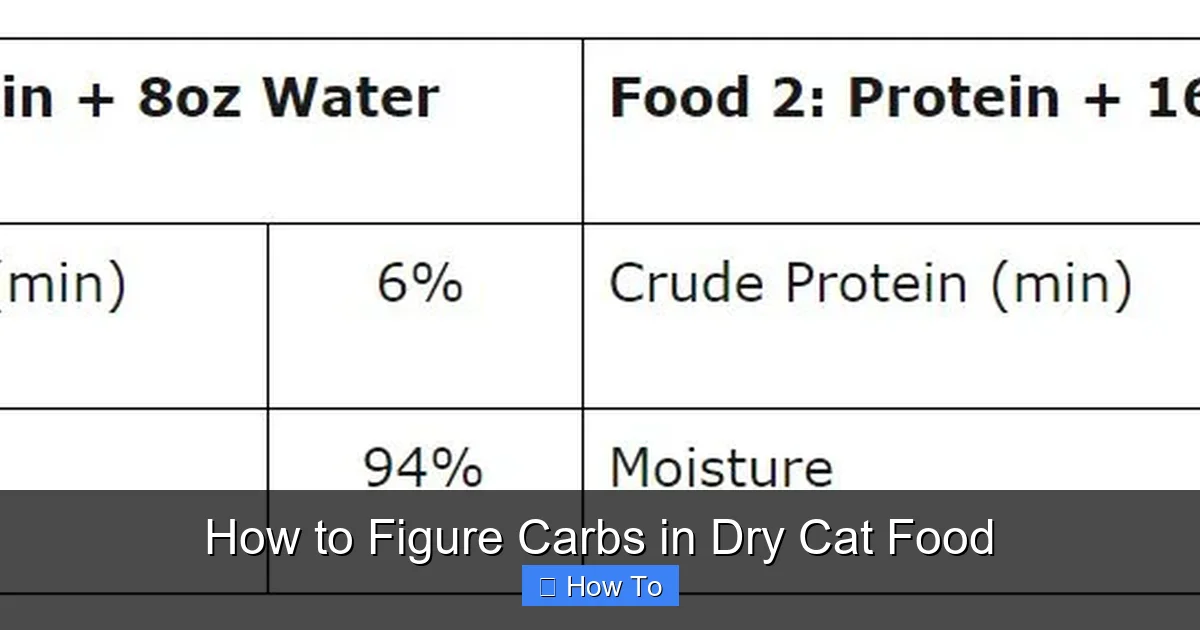
Visual guide about How to Figure Carbs in Dry Cat Food
Image source: thecatsite.com
Before diving into calculations, it’s important to understand why carbohydrates are a big deal for cats. In the wild, cats eat prey like mice and birds—high in protein and fat, and very low in carbs. Their digestive systems are short and designed to process meat quickly, not break down complex plant materials.
When cats consume too many carbohydrates, especially from dry food, their bodies convert the excess into fat. Over time, this can lead to:
– Weight gain and obesity
– Insulin resistance
– Type 2 diabetes
– Urinary tract issues
– Reduced lifespan
Studies from 2025 show that over 60% of domestic cats are overweight or obese, and many of these cases are linked to high-carb dry diets. While dry food is convenient, it’s often higher in carbs than wet or raw diets because starches are needed to bind kibble together.
So, even if your cat seems healthy now, monitoring carb intake can prevent long-term health problems. Figuring out carbs in dry cat food isn’t just about numbers—it’s about giving your cat the best chance at a long, healthy life.
Step 1: Read the Guaranteed Analysis
The first step to figuring out carbs in dry cat food is to locate the “Guaranteed Analysis” on the packaging. This section is required by law and lists the minimum or maximum percentages of key nutrients. It usually looks something like this:
– Crude Protein (min): 30%
– Crude Fat (min): 15%
– Crude Fiber (max): 4%
– Moisture (max): 10%
Note: Ash is sometimes listed separately, but not always. If it’s not, we’ll estimate it.
These percentages are based on an “as-fed” basis, meaning they reflect the food as it comes out of the bag—not on a dry matter basis. This is important because moisture content can skew the numbers. Dry food typically has 6–10% moisture, while wet food can have 75% or more.
Why the Guaranteed Analysis Isn’t Enough
You might be wondering: if the label lists protein, fat, fiber, and moisture, why isn’t there a line for carbohydrates? The answer is simple—manufacturers aren’t required to list it. But that doesn’t mean we can’t figure it out.
The guaranteed analysis gives us the building blocks we need to calculate carbs indirectly. Think of it like a pie chart: the total must add up to 100%. If we know the percentages of protein, fat, moisture, fiber, and ash, we can subtract them from 100% to estimate the remaining portion—carbohydrates.
Step 2: Gather the Numbers
To calculate carbs, you’ll need the following values from the guaranteed analysis:
– Crude Protein (min)
– Crude Fat (min)
– Crude Fiber (max)
– Moisture (max)
– Ash (if listed)
Let’s use a real-world example. Suppose you’re looking at a popular dry cat food with the following guaranteed analysis:
– Crude Protein (min): 32%
– Crude Fat (min): 14%
– Crude Fiber (max): 3.5%
– Moisture (max): 10%
– Ash (max): 7% (if not listed, we’ll use 7% as an average)
These numbers are typical for many mid-range dry foods. Now, let’s plug them into our formula.
Step 3: Use the Carb Calculation Formula
The formula to estimate carbohydrates is:
Carbohydrates (%) = 100% – (Protein % + Fat % + Moisture % + Fiber % + Ash %)
Let’s apply it to our example:
Carbohydrates = 100 – (32 + 14 + 10 + 3.5 + 7)
Carbohydrates = 100 – 66.5
Carbohydrates = 33.5%
So, this dry cat food contains approximately 33.5% carbohydrates.
That’s quite high for a carnivore! For comparison, a healthy low-carb dry food should ideally be under 10–15% carbs.
What If Ash Isn’t Listed?
Ash represents the mineral content left after burning off organic material. It’s not harmful, but it’s part of the total composition. If ash isn’t listed, most nutritionists recommend using 7% as a standard estimate for dry cat food.
So, if your food doesn’t list ash, use this adjusted formula:
Carbohydrates = 100 – (Protein + Fat + Moisture + Fiber + 7)
This keeps your estimate accurate without needing extra data.
Step 4: Convert to Dry Matter Basis (Optional but Recommended)
The calculation above gives you carbs on an “as-fed” basis—meaning it includes moisture. But for a more accurate comparison between foods (especially dry vs. wet), many experts recommend converting to a “dry matter basis.”
Dry matter basis removes the moisture, so you’re comparing just the solid nutrients. This is especially helpful when comparing dry food to wet food, which has much higher moisture.
How to Calculate Dry Matter Basis
Step 1: Subtract moisture from 100 to get the dry matter percentage.
In our example: 100 – 10 = 90% dry matter
Step 2: Divide each nutrient by the dry matter percentage and multiply by 100.
For protein: (32 / 90) × 100 = 35.6% protein (dry matter)
For fat: (14 / 90) × 100 = 15.6% fat (dry matter)
For fiber: (3.5 / 90) × 100 = 3.9% fiber (dry matter)
For ash: (7 / 90) × 100 = 7.8% ash (dry matter)
Now, calculate carbs on a dry matter basis:
Carbohydrates (dry matter) = 100 – (35.6 + 15.6 + 3.9 + 7.8)
= 100 – 62.9
= 37.1%
So, on a dry matter basis, this food is over 37% carbs—even higher than the as-fed number.
This shows why dry matter calculations are more revealing. A food might look moderate in carbs on the label, but when you remove water, the carb load becomes clearer.
Step 5: Analyze the Ingredient List
While math gives you a number, the ingredient list tells you the story behind it. Ingredients are listed in order by weight, so the first few items make up the bulk of the food.
Watch for These High-Carb Ingredients
If any of these appear in the first five ingredients, the food is likely high in carbs:
– Corn, corn gluten meal, corn flour
– Wheat, wheat gluten, wheat flour
– Rice, brown rice, rice flour
– Barley, oats, sorghum
– Potatoes, sweet potatoes, potato protein
– Peas, lentils, chickpeas
– Tapioca, cassava, soy
These are often used as fillers or binders in kibble. While not all are bad in small amounts, they shouldn’t dominate the recipe.
Look for Animal Proteins First
A high-quality, low-carb dry food should list a named animal protein first—like “chicken,” “turkey,” or “salmon”—not “poultry by-product meal” or “meat meal.”
Better yet, look for foods that list multiple animal proteins early on, such as:
– Deboned chicken
– Chicken meal
– Turkey meal
– Salmon
– Egg product
These indicate a meat-first formula, which typically means lower carbs and higher bioavailable nutrition.
Example: Comparing Two Foods
Let’s compare two dry foods:
Food A:
Ingredients: Chicken, chicken meal, brown rice, peas, potato protein, chicken fat…
Food B:
Ingredients: Corn, chicken by-product meal, wheat gluten, soybean meal, corn gluten meal…
Even without calculating, you can see Food A is likely lower in carbs because animal proteins come first. Food B is packed with plant-based ingredients, signaling high carbohydrate content.
Step 6: Use 2026 Technology to Simplify the Process
In 2026, you don’t have to do all this math by hand. Several apps and online tools can scan pet food labels and estimate carb content instantly.
Top Apps for Figuring Carbs in 2026
– PetNutriScan: Uses your phone’s camera to scan the guaranteed analysis and ingredient list. It calculates carbs, protein, and fat on both as-fed and dry matter bases. Available on iOS and Android.
– CatFoodCalc Pro: A web-based tool where you input the guaranteed analysis, and it does the math for you. Also includes a database of over 1,000 commercial cat foods with pre-calculated carb values.
– VetDiet Assistant: Developed in partnership with veterinary nutritionists, this app not only calculates carbs but also flags potential allergens and compares foods side by side.
These tools save time and reduce human error. Simply snap a photo or type in the numbers, and you’ll get a detailed breakdown in seconds.
Smart Pet Food Labels
Some premium brands in 2026 now include QR codes on packaging that link to a digital nutrition profile. Scanning the code takes you to a page with full macronutrient breakdowns, including carbohydrates, amino acids, and even glycemic index estimates.
This is a game-changer for transparency. While not yet universal, it’s a trend growing rapidly among health-focused pet food companies.
Step 7: Choose the Right Low-Carb Dry Food
Now that you know how to figure carbs, it’s time to make better choices. But what counts as “low-carb” for cats?
Recommended Carb Levels
– Ideal: Under 10% carbohydrates (as-fed)
– Acceptable: 10–20% carbohydrates
– Avoid: Over 20% carbohydrates
Most dry foods fall between 20–40% carbs, so finding one under 10% can be challenging—but not impossible.
Top Low-Carb Dry Cat Foods in 2026
Here are a few brands known for low-carb formulas:
– Ziwi Peak Air-Dried: ~5% carbs, high in meat, no grains or potatoes
– Feline Natural Freeze-Dried: ~3% carbs, made with 95% meat and organs
– Stella & Chewy’s Carnivore Crunch: ~8% carbs, grain-free, high-protein
– Purina Pro Plan Veterinary Diets DM: ~12% carbs, formulated for diabetic cats
Note: Some of these are freeze-dried or air-dried, not traditional kibble. But they offer the convenience of dry food with wet-food-level nutrition.
Homemade and Raw Options
If you’re serious about minimizing carbs, consider homemade or raw diets. These allow full control over ingredients and typically contain less than 5% carbs.
However, they require careful balancing to avoid nutritional deficiencies. Always consult a veterinary nutritionist before switching to a homemade diet.
Troubleshooting Common Challenges
Even with the best tools, you might run into issues. Here’s how to handle common problems.
Problem: The Guaranteed Analysis Is Missing Key Info
Some budget brands omit ash or fiber. If ash isn’t listed, use 7% as an estimate. If fiber is missing, check the ingredient list for fiber sources like beet pulp or cellulose—these usually mean at least 2–4% fiber.
Problem: The Carb Count Seems Too High
Double-check your math. A common mistake is forgetting to include moisture or ash. Also, remember that “crude” protein and fat include non-digestible parts, so the actual usable protein may be slightly lower—but this won’t drastically change carb estimates.
Problem: Your Cat Won’t Eat Low-Carb Food
Cats can be picky. If switching to a low-carb food, do it gradually over 7–10 days. Mix increasing amounts of the new food with the old. You can also try warming the food slightly or adding a small amount of bone broth to enhance flavor.
Problem: Low-Carb Dry Food Is Expensive
It’s true—high-meat, low-carb foods cost more. But consider it an investment in your cat’s health. Fewer vet bills, better energy, and longer life can outweigh the upfront cost. Look for sales, subscribe for discounts, or buy in bulk.
When to Consult Your Veterinarian
While this guide empowers you to make informed choices, your vet should always be part of the conversation—especially if your cat has:
– Diabetes
– Obesity
– Kidney disease
– Pancreatitis
– Food allergies
Your vet can help interpret lab results, recommend specific diets, and monitor your cat’s progress. In 2026, many clinics offer nutritional counseling and even partner with pet nutrition apps to track your cat’s intake over time.
Final Thoughts: Empowerment Through Knowledge
Figuring out carbs in dry cat food doesn’t have to be intimidating. With a little effort, you can uncover the hidden carbohydrate content in your cat’s kibble and make smarter dietary choices. Remember:
– Use the guaranteed analysis and the carb calculation formula
– Check the ingredient list for plant-based fillers
– Convert to dry matter basis for accurate comparisons
– Leverage 2026 technology like apps and QR codes
– Choose foods with animal proteins first and minimal carbs
– Always involve your veterinarian in major diet changes
Your cat can’t read labels or do the math—but you can. By taking the time to understand what’s in their food, you’re giving them the gift of better health, more energy, and a longer, happier life.
Start today. Grab a bag of your cat’s current food, find the guaranteed analysis, and calculate those carbs. You might be surprised by what you discover.