
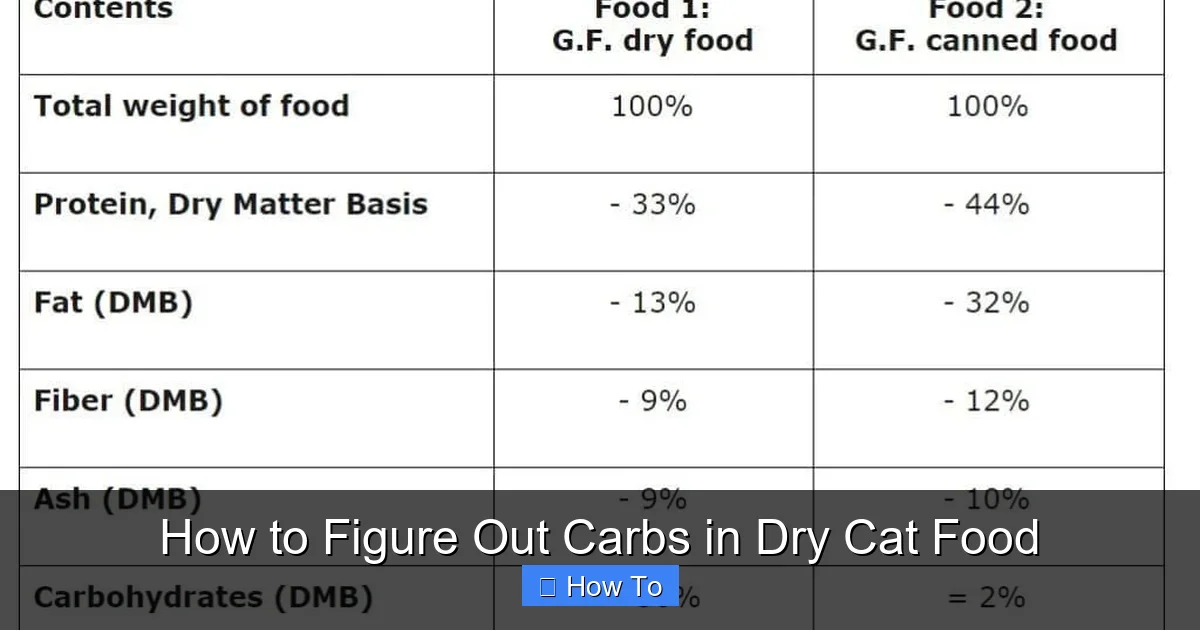
Figuring out carbs in dry cat food is essential for your cat’s health, especially if they have diabetes or weight issues. This guide walks you through reading labels, using online calculators, and understanding ingredient lists to make informed choices.
Key Takeaways
- Carb content isn’t listed on pet food labels – You must calculate it using guaranteed analysis and moisture content.
- Use the nitrogen-free extract (NFE) method – This is the most accurate way to estimate carbs in dry cat food.
- Ingredient order matters – Foods listing grains or starches first tend to be higher in carbs.
- Online calculators simplify the process – Tools like the Pet Nutrition Alliance calculator help you get quick results.
- Low-carb diets support feline health – Cats are obligate carnivores and thrive on high-protein, low-carb meals.
- Always consult your vet – Before switching diets, especially for cats with medical conditions.
- Stay updated in 2026 – New labeling standards and apps make carb tracking easier than ever.
How to Figure Out Carbs in Dry Cat Food
If you’re a cat parent in 2026, you’re likely more informed than ever about your pet’s nutrition. With rising awareness of feline diabetes, obesity, and kidney disease, understanding what’s in your cat’s food has never been more important. One of the biggest concerns? Carbohydrates.
Unlike dog food, cat food—especially dry kibble—often contains hidden carbs that can sneak into your cat’s diet. But here’s the catch: **carbohydrate content isn’t listed on pet food labels**. That means you can’t just glance at the back of the bag and know how many carbs your cat is eating.
So how do you figure it out?
This guide will walk you through the complete process of calculating carbs in dry cat food—step by step. Whether you’re managing your cat’s weight, dealing with a health condition, or simply aiming for a more natural diet, knowing how to assess carb levels empowers you to make smarter choices.
By the end of this guide, you’ll be able to:
– Read and interpret pet food labels like a pro
– Use simple math to estimate carbohydrate content
– Identify high-carb ingredients to avoid
– Use free online tools to speed up the process
– Choose better dry foods for your cat in 2026
Let’s get started.
Why Carbs Matter for Cats
Visual guide about How to Figure Out Carbs in Dry Cat Food
Image source: estore.higbyfeed.com
Before we dive into calculations, let’s talk about why this matters.
Cats are **obligate carnivores**. That means their bodies are built to thrive on animal-based proteins and fats—not plant-based carbs. In the wild, a cat’s diet consists mostly of meat, with minimal carbohydrates. Their digestive systems aren’t designed to process large amounts of starch or sugar.
Yet, many commercial dry cat foods are packed with fillers like corn, wheat, rice, and potatoes—ingredients that boost carb content and lower production costs.
High-carb diets can lead to:
– Weight gain and obesity
– Insulin resistance
– Feline diabetes
– Urinary tract issues
– Poor coat and skin health
In 2026, veterinarians are seeing more cases of diet-related illnesses in cats, and many point to excessive carbohydrate intake as a key factor.
The good news? You can take control. By learning how to figure out carbs in dry cat food, you can choose options that better match your cat’s natural dietary needs.
Step 1: Understand What’s on the Label
The first step in figuring out carbs is knowing how to read a pet food label. While it might look confusing at first, it’s actually structured to give you key nutritional information.
Here’s what you’ll typically find:
Guaranteed Analysis
This section lists the minimum or maximum percentages of key nutrients:
– Crude Protein (minimum %)
– Crude Fat (minimum %)
– Crude Fiber (maximum %)
– Moisture (maximum %)
These numbers are essential for calculating carbs.
Ingredient List
Ingredients are listed in order by weight. The first few ingredients make up the bulk of the food. If you see grains, starches, or plant-based fillers near the top, the food is likely high in carbs.
Calorie Content
Usually listed as “kcal per cup” or “kcal per kg.” This helps you understand energy density but doesn’t directly tell you about carbs.
Life Stage and Feeding Guidelines
These help you determine portion sizes but aren’t directly related to carb calculation.
The key takeaway? **The guaranteed analysis is your best friend** when estimating carbs.
Step 2: Use the Nitrogen-Free Extract (NFE) Method
Since carbs aren’t listed, we use a formula called the **Nitrogen-Free Extract (NFE) method**. It’s the most widely accepted way to estimate carbohydrate content in pet food.
Here’s how it works:
Carbohydrates (as NFE) = 100 – (% moisture + % protein + % fat + % fiber + % ash)
Let’s break that down.
What Each Component Means
– **Moisture**: Water content. Dry food usually has 6–10% moisture.
– **Protein**: Animal or plant-based protein. Look for the “crude protein” value.
– **Fat**: Essential for energy. Listed as “crude fat.”
– **Fiber**: Indigestible plant material. Listed as “crude fiber.”
– **Ash**: Mineral content left after burning the food. Not always listed, but often estimated at 6–8% if missing.
Example Calculation
Let’s say you have a dry cat food with the following guaranteed analysis:
– Moisture: 10%
– Crude Protein: 32%
– Crude Fat: 15%
– Crude Fiber: 3%
– Ash: 7% (assumed if not listed)
Now plug into the formula:
Carbs (NFE) = 100 – (10 + 32 + 15 + 3 + 7)
Carbs (NFE) = 100 – 67
Carbs (NFE) = 33%
So, this food is approximately **33% carbohydrates**.
That’s quite high for a cat. Ideally, you want dry food under 10–15% carbs.
Step 3: Find the Ash Content (If Not Listed)
Ash isn’t always listed on labels, but it’s a critical part of the formula. Ash represents the inorganic minerals (like calcium, phosphorus, magnesium) left after combustion.
If your food doesn’t list ash, you can estimate it:
– Most dry cat foods have **6–8% ash**.
– High-mineral diets (like those for urinary health) may have up to 10%.
– Grain-free or high-meat diets may be on the lower end (6%).
When in doubt, use **7%** as a safe average.
Tip: Contact the Manufacturer
If you want precise numbers, email or call the pet food company. Many now provide full nutritional profiles, including ash and carbohydrate estimates, especially as consumer demand grows in 2026.
Step 4: Adjust for Dry Matter Basis
The numbers on the label are “as-fed,” meaning they include moisture. To compare foods fairly, you need to convert them to **dry matter basis (DMB)**.
Why? Because moisture dilutes the percentages. A food with 10% moisture has more concentrated nutrients than one with 12%.
Here’s how to convert:
Dry Matter % = 100 – % Moisture
Then, for each nutrient:
Nutrient (DMB) = (Nutrient % as-fed ÷ Dry Matter %) × 100
Example: Converting Protein to DMB
Food A:
– Moisture: 10%
– Crude Protein: 32%
Dry Matter = 100 – 10 = 90%
Protein (DMB) = (32 ÷ 90) × 100 = 35.6%
Now do the same for fat, fiber, and ash. Then recalculate carbs using the NFE formula on a dry matter basis.
This gives you a more accurate comparison between brands.
Step 5: Use Online Carb Calculators
Doing math by hand every time? Not fun.
Luckily, in 2026, there are free online tools that do the work for you.
Recommended Tools
– **Pet Nutrition Alliance Carb Calculator** – Simple, reliable, and widely used by vets.
– **Feline Nutrition Foundation Calculator** – Includes DMB conversion and compares to ideal ranges.
– **PetFoodCalculator.com** – Allows you to input multiple brands and compare side by side.
These tools let you enter the guaranteed analysis, and they spit out the estimated carb percentage—often with a color-coded rating (green for low, red for high).
How to Use Them
1. Go to the calculator website.
2. Enter the moisture, protein, fat, fiber, and ash values.
3. Click “Calculate.”
4. Review the results and recommendations.
Some apps even let you scan the barcode of the food bag and pull up the data automatically—perfect for 2026 tech-savvy pet parents.
Step 6: Read the Ingredient List Like a Pro
Even with calculations, the ingredient list gives you clues about carb content.
High-Carb Ingredients to Watch For
– Corn (corn gluten meal, whole grain corn)
– Wheat (wheat gluten, wheat flour)
– Rice (brewer’s rice, brown rice)
– Potatoes (potato starch, dehydrated potatoes)
– Peas, lentils, chickpeas (common in “grain-free” foods)
– Tapioca, barley, oats
If any of these appear in the **top 5 ingredients**, the food is likely high in carbs—even if it’s labeled “grain-free.”
Low-Carb Indicators
– Named meat sources first (chicken, turkey, salmon)
– Meat meals (chicken meal, turkey meal)
– Animal fats (chicken fat, salmon oil)
– Limited or no grains or starches
Example: Comparing Two Foods
**Food A (High-Carb):**
1. Chicken
2. Corn gluten meal
3. Brewers rice
4. Wheat gluten
5. Chicken by-product meal
→ Likely 30–40% carbs
**Food B (Low-Carb):**
1. Deboned turkey
2. Turkey meal
3. Chicken meal
4. Peas
5. Chicken fat
→ Peas are a starch, but lower on the list. Likely 15–20% carbs.
Even “grain-free” doesn’t mean low-carb. Peas and lentils are starchy and can push carb levels up.
Step 7: Consider Your Cat’s Health Needs
Not all cats need ultra-low-carb food. But many benefit from it.
Cats Who Need Low-Carb Diets
– Overweight or obese cats
– Diabetic cats
– Cats with urinary crystals or stones
– Senior cats with reduced metabolism
– Cats with inflammatory bowel disease (IBD)
For these cats, aim for dry food under **10–15% carbs** on a dry matter basis.
Cats Who Can Tolerate More Carbs
– Healthy, active kittens (need more energy)
– Nursing mothers
– Very active outdoor cats
Still, even for these cats, minimizing unnecessary carbs is wise.
Step 8: Compare Brands and Make Smart Switches
Now that you know how to calculate carbs, it’s time to shop smarter.
Top Low-Carb Dry Cat Foods in 2026
Based on recent reviews and nutritional analysis:
– **Ziwi Peak Air-Dried Cat Food** – ~5% carbs, high meat content
– **Tiki Cat Born Carnivore** – ~8% carbs, grain-free, high protein
– **Wellness CORE Grain-Free** – ~12% carbs, balanced for most cats
– **Instinct Original Grain-Free** – ~10% carbs, includes freeze-dried raw pieces
Always double-check the latest formulas—brands update recipes frequently.
How to Transition Safely
Switching foods too fast can upset your cat’s stomach. Follow this 7-day plan:
– Days 1–2: 25% new food, 75% old
– Days 3–4: 50% new, 50% old
– Days 5–6: 75% new, 25% old
– Day 7: 100% new food
Watch for vomiting, diarrhea, or refusal to eat. If issues persist, consult your vet.
Troubleshooting Common Problems
Problem: The Food Doesn’t List Ash
Solution: Use 7% as an estimate. If the brand is reputable, they likely fall within the 6–8% range. For precision, contact the manufacturer.
Problem: The Carb Percentage Seems Too High
Solution: Double-check your math. Ensure you’re using dry matter basis for fair comparison. Some “grain-free” foods use legumes, which are still high in carbs.
Problem: My Cat Won’t Eat Low-Carb Food
Solution: Try mixing in a small amount of wet food or topping with bone broth. Some cats prefer the texture of wet food, which is naturally lower in carbs.
Problem: I Can’t Afford Premium Low-Carb Brands
Solution: Look for sales, subscribe for discounts, or consider a mix of dry and wet food. Even adding 50% wet food can cut overall carb intake significantly.
The Future of Cat Food Labels in 2026
Great news: In 2026, pet food labeling is becoming more transparent.
The FDA and AAFCO are pushing for **mandatory carbohydrate disclosure** on pet food labels. Some brands already voluntarily list “calculated carbs” or “net carbs.”
Additionally, QR codes on packaging now link to full nutritional breakdowns, including amino acid profiles and mineral content.
Apps like **PetNutriScan** let you scan a bag and instantly see carb estimates, ingredient sourcing, and vet reviews.
These advancements make it easier than ever to figure out carbs in dry cat food—no calculator needed.
Final Tips for 2026 Cat Parents
– **Prioritize protein**: Look for foods with 40%+ protein on a dry matter basis.
– **Limit starchy ingredients**: Even “healthy” grains and legumes add carbs.
– **Use online tools**: Save time and reduce errors.
– **Consult your vet**: Especially if your cat has health issues.
– **Consider wet food**: It’s naturally lower in carbs and higher in moisture—great for kidney health.
Conclusion
Figuring out carbs in dry cat food doesn’t have to be complicated. With the NFE method, dry matter conversion, and a few online tools, you can make informed decisions that support your cat’s long-term health.
Remember: cats don’t need carbs to thrive—they need high-quality animal protein. By choosing low-carb dry foods and reading labels carefully, you’re giving your feline friend the best chance at a healthy, happy life in 2026 and beyond.
Start today. Grab a bag of your cat’s current food, pull up a calculator, and see where it stands. Your cat will thank you.