
Understanding how to calculate calories in cat food is essential for keeping your feline friend healthy and at an ideal weight. This guide walks you through reading labels, using formulas, and adjusting portions based on your cat’s age, activity level, and health needs—so you can make informed feeding decisions with confidence.
Key Takeaways
- Calorie content is listed as “kcal/kg” or “kcal per cup” on pet food labels: Always check the nutrition facts panel to find the energy density of the food.
- Use the Resting Energy Requirement (RER) formula to estimate daily needs: RER = 70 × (body weight in kg)^0.75 gives a baseline for calorie requirements.
- Adjust RER based on lifestyle: Multiply RER by factors like 1.2 for neutered adults or 1.8 for active kittens to get the Daily Energy Requirement (DER).
- Weigh your cat regularly: Fluctuations in weight signal whether you’re feeding too many or too few calories.
- Wet and dry foods differ significantly in caloric density: Wet food is lower in calories per volume, so portion sizes vary greatly between formats.
- Consult your vet for medical conditions: Cats with diabetes, obesity, or thyroid issues need customized calorie plans.
- Track feeding amounts and monitor body condition: Use a consistent measuring cup and score your cat’s physique monthly to stay on track.
Why Calculating Calories in Cat Food Matters
Feeding your cat the right number of calories isn’t just about filling their bowl—it’s about supporting their long-term health, energy levels, and quality of life. Just like humans, cats need a balanced intake of nutrients and energy. Too few calories can lead to malnutrition, weight loss, and weakened immunity. Too many calories? That’s a fast track to obesity, diabetes, joint problems, and reduced lifespan.
The truth is, most commercial cat foods don’t come with personalized feeding instructions. Labels suggest broad ranges like “1/2 to 3/4 cup per day,” but these are generic guidelines. Your indoor senior cat and your rambunctious kitten have vastly different energy needs. That’s why learning how to calculate calories in cat food is a game-changer for responsible pet ownership.
In this guide, you’ll learn how to decode pet food labels, use simple math to estimate your cat’s daily calorie needs, and adjust portions based on real-world factors like age, activity level, and health status. Whether you’re feeding dry kibble, canned wet food, or a mix of both, you’ll walk away with the tools to create a feeding plan that keeps your cat thriving.
Step 1: Understand How Calories Are Listed on Cat Food Labels

Visual guide about How to Calculate Calories in Cat Food
Image source: cdn.shopify.com
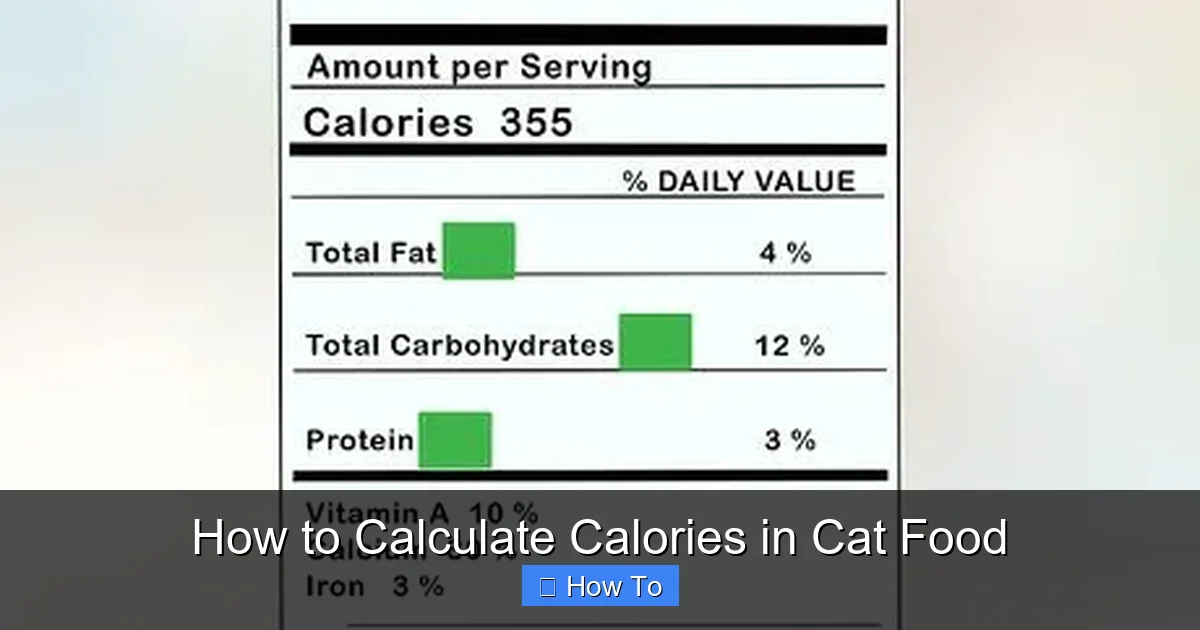
The first step in calculating calories in cat food is knowing where to find the information. Pet food labels in the U.S. are regulated by the Association of American Feed Control Officials (AAFCO), which requires manufacturers to list nutritional content—including calorie density.
Look for a section titled “Guaranteed Analysis” or “Nutritional Information.” Within that, you’ll find the calorie content expressed in one of two ways:
– **kcal/kg (kilocalories per kilogram)**: This is the standard scientific measure of energy density.
– **kcal per cup or per can**: Some brands also list calories per common serving size, which is helpful but not always present.
For example, a bag of dry food might say: “Calorie Content: 3800 kcal/kg (metabolizable energy).” A can of wet food might say: “Calorie Content: 180 kcal per 5.5 oz can.”
Why kcal/kg Matters More Than Serving Size
While “kcal per cup” sounds convenient, it can be misleading. Different brands have different kibble densities—some are light and airy, others are dense and compact. A “cup” of one brand might contain far more calories than a “cup” of another.
That’s why kcal/kg is the gold standard. It tells you how much energy is in a fixed weight of food, making it easy to compare products and calculate precise portions.
How to Convert kcals to More Useful Units
Once you have the kcal/kg value, you can convert it to calories per ounce or per gram for easier measurement:
– 1 kg = 35.27 ounces
– So, if a food has 3800 kcal/kg, then:
– Calories per ounce = 3800 ÷ 35.27 ≈ 108 kcal/oz
– Calories per gram = 3800 ÷ 1000 = 3.8 kcal/g
This helps when you’re measuring small amounts or using a kitchen scale.
Practical Example: Reading a Label
Let’s say you’re looking at a 12-oz bag of dry cat food. The label says:
> “Calorie Content (ME): 4200 kcal/kg”
You want to know how many calories are in one cup. But the label doesn’t list kcal per cup. Here’s what to do:
1. Weigh one cup of kibble using a kitchen scale. Suppose it weighs 100 grams.
2. Multiply by the kcal/kg value: 4200 kcal/kg × 0.1 kg = 420 kcal per cup.
Now you know: one cup of this food contains about 420 calories.
Step 2: Determine Your Cat’s Daily Calorie Needs
Now that you know how to find the calorie content of the food, the next step is figuring out how many calories your cat actually needs each day. This isn’t a one-size-fits-all number. It depends on several factors, including weight, age, activity level, and health status.
The best way to estimate this is by using the **Resting Energy Requirement (RER)** formula, followed by adjusting for lifestyle.
Calculate Resting Energy Requirement (RER)
RER is the number of calories your cat needs per day to maintain basic bodily functions—like breathing, digestion, and circulation—while at rest. It’s the foundation for all calorie calculations.
The formula is:
RER = 70 × (body weight in kg)^0.75
Let’s break this down:
– First, convert your cat’s weight from pounds to kilograms. Divide pounds by 2.2.
– Example: A 10-pound cat = 10 ÷ 2.2 ≈ 4.55 kg
– Then raise the weight to the power of 0.75.
– 4.55^0.75 ≈ 3.0 (use a calculator with an exponent function)
– Multiply by 70: 70 × 3.0 = 210 kcal/day
So, a 10-pound cat has an RER of about 210 calories per day.
Adjust RER to Get Daily Energy Requirement (DER)
RER is just the baseline. Most cats need more energy than this because they’re not in a coma—they move, play, groom, and explore. To get the **Daily Energy Requirement (DER)**, multiply the RER by a factor based on your cat’s lifestyle.
Here are common adjustment factors:
| Cat Type | Adjustment Factor |
|——–|——————|
| Neutered adult (indoor, low activity) | 1.2 × RER |
| Intact adult (outdoor or active) | 1.4 × RER |
| Kitten (under 1 year) | 2.0–3.0 × RER |
| Senior cat (over 7 years, low activity) | 1.0–1.2 × RER |
| Obese cat (weight loss plan) | 0.8–1.0 × RER |
| Underweight cat (weight gain) | 1.4–1.6 × RER |
Let’s continue with our 10-pound (4.55 kg) indoor neutered cat:
– RER = 210 kcal
– DER = 210 × 1.2 = 252 kcal/day
So, this cat needs about 250 calories per day to maintain a healthy weight.
Special Considerations
– **Pregnant or nursing cats**: These cats need 2–3 times their RER, especially in the later stages of pregnancy and while nursing kittens.
– **Cats with medical conditions**: Hyperthyroidism increases metabolism, so calorie needs may be higher. Diabetes or kidney disease may require lower-calorie or specialized diets. Always consult your vet.
– **Extreme temperatures**: Cats in very cold environments may need more calories to stay warm.
Step 3: Match Calorie Needs to Food Type and Portion Size
Now that you know your cat needs about 250 calories per day, it’s time to figure out how much food to feed. This depends on whether you’re using dry food, wet food, or a combination.
Calculating Portions for Dry Food
Dry food is typically high in calories per volume. Let’s say your dry food has 4200 kcal/kg, and one cup weighs 100 grams (as in our earlier example).
– Calories per cup = 420 kcal
– Your cat needs 250 kcal/day
– Portion size = 250 ÷ 420 ≈ 0.6 cups
So, feed about 5/8 of a cup per day. You can split this into two meals: ~5 tablespoons in the morning and ~5 tablespoons at night.
Calculating Portions for Wet Food
Wet food is much lower in calories per volume because it’s mostly water (70–80%). Let’s say a 5.5-oz (156g) can has 180 kcal.
– Your cat needs 250 kcal
– One can = 180 kcal
– So, 250 ÷ 180 ≈ 1.4 cans per day
That means feeding one full can and about 2/3 of another can daily. You could do one full can in the morning and the rest in the evening.
Combining Wet and Dry Food
Many owners feed a mix of wet and dry food. This can help with hydration and dental health. Here’s how to calculate a combo diet:
Suppose you want to feed:
– 1 can of wet food (180 kcal)
– The rest from dry food (250 – 180 = 70 kcal needed)
From earlier, dry food has 420 kcal per cup, so:
– 70 ÷ 420 ≈ 0.17 cups (about 2.7 tablespoons)
So, feed one can of wet food and about 3 tablespoons of dry food per day.
Using a Kitchen Scale for Precision
Measuring cups can be inconsistent. A kitchen scale is more accurate, especially for small portions.
For example, if your dry food has 3.8 kcal/gram (from 3800 kcal/kg), and your cat needs 70 kcal from dry food:
– 70 ÷ 3.8 ≈ 18.4 grams
Weigh out 18 grams of kibble—that’s your precise portion.
Step 4: Monitor and Adjust Based on Your Cat’s Response
Calculating calories is just the beginning. The real test is how your cat responds over time. Weight changes, energy levels, and body condition are your best indicators.
Weigh Your Cat Regularly
Weigh your cat every 2–4 weeks using a pet scale or by weighing yourself holding them and subtracting your weight. Track the results in a notebook or app.
– If your cat is gaining weight: You’re likely feeding too many calories. Reduce portions by 10% and monitor.
– If your cat is losing weight: Increase calories slightly or check for underlying health issues.
Assess Body Condition Score (BCS)
The Body Condition Score is a visual and tactile way to evaluate your cat’s weight. Most vets use a 5-point or 9-point scale. Here’s a simplified 5-point version:
– **1 (Too thin)**: Ribs, spine, and bones are highly visible. No fat cover.
– **2 (Underweight)**: Ribs easily felt, minimal fat. Waist and abdominal tuck obvious.
– **3 (Ideal)**: Ribs felt with light pressure, waist visible from above, slight abdominal tuck.
– **4 (Overweight)**: Ribs hard to feel, waist absent, fat deposits over base of tail.
– **5 (Obese)**: Ribs not palpable, large fat deposits, no waist, bulging abdomen.
Aim for a BCS of 3. If your cat is a 4 or 5, work with your vet to create a safe weight-loss plan.
Watch for Behavioral and Health Clues
– **Lethargy or low energy**: Could mean too few calories or an underlying illness.
– **Excessive hunger or begging**: Might indicate underfeeding or a medical issue like diabetes.
– **Vomiting or diarrhea**: Could be due to overfeeding, food intolerance, or illness.
Troubleshooting Common Calorie Calculation Mistakes
Even with the best intentions, it’s easy to make errors. Here are common pitfalls and how to avoid them.
Mistake 1: Relying Only on Feeding Guidelines on the Bag
Feeding charts on bags are estimates based on average cats. They don’t account for individual differences. Always use them as a starting point, not a rule.
Mistake 2: Ignoring Treats and Snacks
Treats can add significant calories. If your cat gets 50 kcal in treats per day, that’s 20% of a 250-kcal diet. Either reduce main meals or choose low-calorie treats.
Mistake 3: Not Adjusting for Life Changes
A kitten’s calorie needs drop after spaying/neutering. An indoor cat’s needs decrease with age. Recalculate DER whenever your cat’s lifestyle changes.
Mistake 4: Mixing Foods Without Recalculating
If you switch from all-dry to half-wet, the calorie math changes. Always recalculate portions when changing food types or brands.
Mistake 5: Forgetting Water Content in Wet Food
Wet food has fewer calories per ounce than dry food. Don’t assume a 5-oz can is equivalent to 5 oz of dry food—it’s not.
Tools and Resources to Make It Easier
You don’t have to do this alone. Several tools can simplify calorie calculations:
– **Pet calorie calculators**: Websites like PetMD or VetCalculators.com have free RER/DER calculators.
– **Kitchen scale**: A digital scale that measures in grams is ideal for precision.
– **Feeding journals**: Apps like “Pet Manager” or a simple notebook help track food, weight, and behavior.
– **Veterinary support**: Your vet can help interpret body condition, adjust for health issues, and recommend diets.
Conclusion
Learning how to calculate calories in cat food empowers you to take control of your cat’s nutrition. It’s not about strict dieting—it’s about making informed, loving choices that support a long, healthy life.
Start by reading labels carefully, use the RER formula to estimate needs, adjust for your cat’s unique lifestyle, and monitor their response. Whether you’re feeding dry, wet, or a mix, precise portions based on calories—not guesswork—lead to better outcomes.
Remember, every cat is different. What works for your neighbor’s cat might not work for yours. Stay observant, stay flexible, and don’t hesitate to consult your veterinarian if you’re unsure.
With a little math and a lot of love, you can ensure your feline friend gets exactly the right amount of energy—every single day.