

Figuring out how much cat food to feed your pet doesn’t have to be confusing. This guide walks you through easy steps to calculate the right portion size based on your cat’s weight, age, lifestyle, and food type—keeping them healthy and happy.
Key Takeaways
- Know your cat’s ideal weight: Use your vet’s guidance or body condition scoring to determine if your cat is underweight, ideal, or overweight—this affects calorie needs.
- Check the food label: Every cat food brand lists feeding guidelines based on weight; use this as a starting point, not a final answer.
- Adjust for life stage: Kittens, adults, and senior cats have different nutritional needs—feed accordingly.
- Factor in activity level: Indoor, sedentary cats need fewer calories than active outdoor cats.
- Monitor and tweak: Weigh your cat monthly and adjust portions if they’re gaining or losing weight unexpectedly.
- Split meals wisely: Divide daily food into 2–3 meals to aid digestion and prevent overeating.
- Consult your vet: Always confirm feeding plans with a veterinarian, especially for health conditions like diabetes or kidney disease.
How to Calculate How Much Cat Food: A Complete Guide
Feeding your cat the right amount of food is one of the most important things you can do for their health. Too little, and they might miss out on essential nutrients. Too much, and they could become overweight or even obese—leading to serious health problems like diabetes, joint issues, and heart disease. But how do you know exactly how much to feed? The answer isn’t one-size-fits-all. It depends on your cat’s weight, age, activity level, metabolism, and even the type of food you’re using.
In this guide, we’ll walk you through a simple, step-by-step process to calculate how much cat food your furry friend really needs. Whether you’re feeding dry kibble, wet food, or a mix of both, you’ll learn how to personalize portions for your cat’s unique needs. We’ll also cover common mistakes, troubleshooting tips, and how to adjust over time. By the end, you’ll feel confident that you’re giving your cat the perfect amount—no guesswork required.
Step 1: Determine Your Cat’s Ideal Weight
Before you can calculate how much cat food to feed, you need to know your cat’s ideal weight. This isn’t always the same as their current weight—especially if they’re overweight or underweight.
Why Ideal Weight Matters
Cats come in all shapes and sizes, but most healthy adult cats weigh between 8 and 10 pounds. However, breed, frame size, and muscle mass play a big role. A Maine Coon might naturally weigh 15 pounds and be perfectly healthy, while a Siamese at 12 pounds could be overweight.
Feeding based on current weight alone can lead to overfeeding if your cat is already heavy. That’s why it’s better to aim for their ideal weight—the weight at which they have a visible waist, you can feel (but not see) their ribs, and their abdomen tucks up slightly when viewed from the side.
How to Assess Your Cat’s Body Condition
Veterinarians use a system called Body Condition Scoring (BCS) to evaluate a cat’s weight. You can do a basic version at home:
- Rib Check: Gently run your hands along your cat’s ribcage. In an ideal-weight cat, you should be able to feel the ribs with a slight fat covering—like feeling the knobs on a well-padded chair.
- Waist View: Look down at your cat from above. You should see a noticeable waistline between the ribs and hips.
- Side Profile: From the side, the belly should tuck up slightly behind the ribs—not hang down.
If you can’t feel the ribs easily, your cat may be overweight. If the ribs are very prominent and the waist is extremely narrow, they might be underweight.
Ask Your Vet for Help
If you’re unsure, schedule a quick vet visit. Your veterinarian can assess your cat’s body condition and recommend an ideal weight range. This is especially important for cats with health issues or those who have recently lost or gained weight.
Step 2: Check the Feeding Guidelines on the Food Label
Once you know your cat’s ideal weight, the next step is to look at the feeding chart on your cat food packaging. Most commercial cat foods—both dry and wet—include a recommended daily amount based on weight.
Understanding the Label
For example, a bag of dry food might say:
“For adult cats weighing 8–10 lbs, feed 1/3 to 1/2 cup per day.”
Or a can of wet food might recommend:
“Feed one 5.5 oz can per 6–8 lbs of body weight daily.”
These guidelines are a great starting point, but they’re not perfect. They’re based on average needs and may not account for your cat’s metabolism, activity level, or health status.
Why Labels Aren’t Always Accurate
Feeding charts are generalized. They assume your cat is healthy, moderately active, and at an ideal weight. But real life is more complicated. A sedentary indoor cat may need 20% fewer calories than the label suggests, while a playful kitten might need more.
Also, calorie density varies between brands. One cup of Brand A might have 400 calories, while one cup of Brand B has 350. Always check the calorie content per cup or can—usually listed as “kcal/kg” or “kcal per cup”—to make accurate comparisons.
Convert Weight to Calories (Optional but Helpful)
If you want to be extra precise, you can calculate your cat’s daily calorie needs and match them to the food’s calorie content.
Most adult cats need about 20 calories per pound of body weight per day to maintain their weight. So an 8-pound cat needs roughly 160 calories daily.
Here’s a quick formula:
Daily Calories = Ideal Weight (lbs) × 20
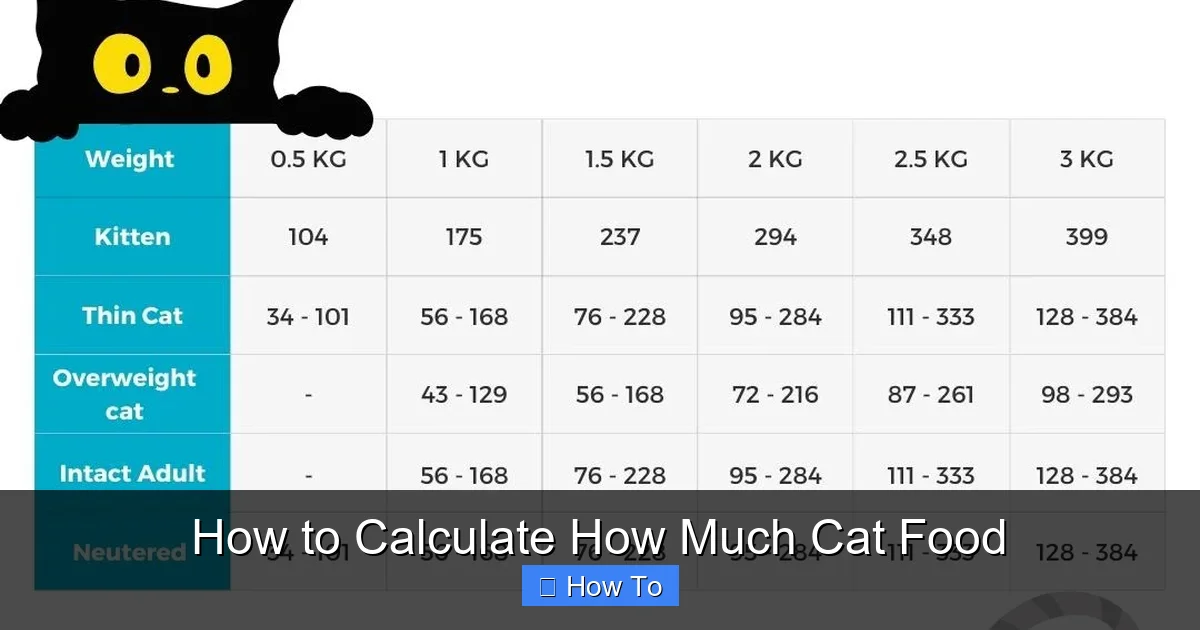
Visual guide about How to Calculate How Much Cat Food
Image source: vetic.in
For example:
- 8 lb cat: 8 × 20 = 160 calories/day
- 10 lb cat: 10 × 20 = 200 calories/day
- 15 lb cat: 15 × 20 = 300 calories/day
Then, check how many calories are in your cat food. If your dry food has 380 calories per cup, and your cat needs 160 calories, they’d need about 0.42 cups (roughly 1/2 cup) per day.
Step 3: Adjust for Life Stage
Cats have different nutritional needs at different stages of life. Feeding a kitten the same amount as an adult cat—or vice versa—can lead to serious health issues.
Kittens (Under 1 Year)
Kittens are growing rapidly and need more calories and nutrients per pound of body weight than adult cats. They typically need 2–3 times the calories of an adult cat.
Most kittens should be fed 3–4 small meals per day until they’re about 6 months old, then transition to 2–3 meals.
Feeding guidelines for kitten food are usually higher—often 1/4 to 1/2 cup of dry food per meal, depending on age and weight. Always use kitten-specific food, as it’s higher in protein, fat, and essential nutrients like DHA for brain development.
Adult Cats (1–7 Years)
This is the stage where most cats are at their peak health and activity level. They need a balanced diet to maintain weight and energy.
Use the 20 calories per pound rule as a baseline, but adjust based on activity. A moderately active adult cat may stay right around that number, while a very active cat might need 25 calories per pound.
Senior Cats (7+ Years)
As cats age, their metabolism slows down. Many senior cats become less active and may gain weight if their food intake isn’t reduced.
However, some senior cats lose weight due to dental issues, reduced appetite, or health problems like hyperthyroidism. In these cases, they may need more calories or a special diet.
Senior cats often benefit from food that’s easier to digest, lower in phosphorus (for kidney health), and higher in fiber. Talk to your vet about whether a senior formula is right for your cat.
Step 4: Factor in Activity Level
Not all cats burn calories at the same rate. A cat that spends its days napping on the couch will need far less food than one that sprints around the house chasing toys or spends time outdoors.
Sedentary Cats
Indoor cats with low activity levels are prone to weight gain. If your cat sleeps most of the day and rarely plays, reduce their food by 10–20% from the label recommendation.
For example, if the label says to feed 1/2 cup per day, try 2/5 cup (about 0.4 cups) instead.
Active Cats
Cats that play frequently, climb, explore, or go outside may need more food. Increase their portions slightly—by about 10–15%—if they’re maintaining a healthy weight.
Watch for signs of hunger, like meowing at the food bowl or scavenging. But don’t overfeed—obesity is still a risk even for active cats.
Indoor vs. Outdoor Cats
Outdoor cats typically burn more calories due to hunting, climbing, and exploring. They may need 25–30 calories per pound instead of 20.
However, outdoor cats are also at higher risk for parasites, injuries, and diseases. Many vets recommend keeping cats indoors for safety—and adjusting food portions accordingly.
Step 5: Choose the Right Type of Food
The type of food you feed—dry, wet, or a combination—affects how much you should give.
Dry Food
Dry kibble is calorie-dense and convenient, but it’s easy to overfeed. One cup can contain 300–500 calories, depending on the brand.
Because dry food is often left out for free-feeding, many cats eat more than they need. It’s better to measure portions and feed at set times.
Wet Food
Wet food has high water content (70–80%), which helps with hydration and makes it less calorie-dense. A 5.5 oz can might have only 150–200 calories.
Wet food can help with weight management and is often recommended for cats with urinary issues. However, it spoils quickly once opened, so it’s best fed in meals rather than left out all day.
Combination Feeding
Many owners feed a mix of wet and dry food. This can provide the benefits of both—hydration from wet food and dental benefits from crunchy kibble.
When combining, calculate the total daily calories from both sources. For example:
- 1/2 cup dry food (200 calories) + 1 can wet food (170 calories) = 370 calories total
Adjust portions so the total matches your cat’s daily needs.
Step 6: Divide Meals Throughout the Day
Cats are natural grazers and prefer small, frequent meals. In the wild, they’d eat 10–20 tiny meals a day. While we don’t need to go that far, splitting food into 2–3 meals helps with digestion and prevents overeating.
How Many Meals?
- Kittens: 3–4 meals per day
- Adult cats: 2–3 meals per day
- Senior cats: 2 meals per day, or as recommended by your vet
Free-feeding (leaving dry food out all day) can lead to obesity, especially in indoor cats. Measured meals give you better control.
Use a Food Scale for Accuracy
Measuring cups can be inconsistent—kibble size varies, and packing affects volume. For the most accurate portions, use a digital kitchen scale.
Weigh your cat’s daily food amount, then divide it into meals. For example, if your cat needs 160 calories and your food has 400 calories per cup (about 100 grams), they need 40 grams per day. Split that into two 20-gram meals.
Step 7: Monitor and Adjust Over Time
Calculating how much cat food to feed isn’t a one-time task. Your cat’s needs change with age, health, and lifestyle. Regular monitoring ensures they stay at a healthy weight.
Weigh Your Cat Monthly
Use a pet scale or weigh yourself holding your cat, then subtract your weight. Track changes over time.
A healthy weight gain or loss is about 1–2% of body weight per month. More than that could signal a problem.
Watch for Signs of Overfeeding or Underfeeding
- Overfeeding signs: Weight gain, lethargy, difficulty grooming, vomiting, or diarrhea.
- Underfeeding signs: Weight loss, dull coat, low energy, excessive meowing for food.
If your cat is gaining weight, reduce portions by 10% and increase playtime. If they’re losing weight unexpectedly, consult your vet—it could indicate an underlying health issue.
Adjust for Life Changes
Major changes—like spaying/neutering, moving to a new home, or introducing a new pet—can affect appetite and activity. Spayed/neutered cats often need 20–30% fewer calories due to a slower metabolism.
After surgery, reduce food gradually over a few weeks to prevent rapid weight gain.
Troubleshooting Common Feeding Problems
Even with the best calculations, feeding issues can arise. Here’s how to handle common problems.
My Cat Is Always Hungry
If your cat acts hungry all the time, it could be:
- Not getting enough calories
- Eating too fast and not feeling full
- A medical issue like diabetes or hyperthyroidism
First, double-check your portion size. If it’s correct, try feeding smaller, more frequent meals or using a slow-feeder bowl. If hunger persists, see your vet.
My Cat Won’t Eat the Right Amount
Some cats are picky or lose interest in food. Try:
- Warming wet food slightly to enhance smell
- Switching flavors or textures
- Feeding in a quiet, stress-free area
Never force-feed or drastically change diets without vet advice.
My Cat Is Gaining Weight
Weight gain is usually due to overfeeding or lack of exercise. Solutions:
- Reduce portions by 10–15%
- Switch to a weight-management formula
- Increase playtime with toys, laser pointers, or climbing structures
- Use puzzle feeders to slow eating and stimulate the mind
My Cat Is Losing Weight
Unintentional weight loss is a red flag. Possible causes:
- Dental pain
- Digestive issues
- Kidney disease
- Cancer
See your vet immediately for diagnosis and treatment.
Conclusion
Calculating how much cat food to feed doesn’t have to be stressful. By starting with your cat’s ideal weight, using the food label as a guide, and adjusting for age, activity, and food type, you can create a feeding plan that supports their health and happiness.
Remember, every cat is unique. What works for one may not work for another. The key is observation, consistency, and regular check-ins with your vet.
Feeding the right amount isn’t just about preventing obesity—it’s about giving your cat the best possible life. With the right portions, your feline friend will have more energy, a shinier coat, and a longer, healthier future.
So grab that measuring cup (or better yet, a scale), check those labels, and start feeding with confidence. Your cat will thank you—with purrs, head bumps, and maybe even a slow blink.