
Understanding how to calculate phosphorus in cat food is crucial for managing feline kidney health and overall nutrition. This guide walks you through simple steps to interpret labels, convert values, and make informed dietary choices for your cat.
Key Takeaways
- Phosphorus matters for kidney health: High phosphorus levels can worsen kidney disease in cats, so monitoring intake is essential.
- Check the guaranteed analysis: Always look for phosphorus content on the pet food label under the guaranteed analysis section.
- Convert to dry matter basis: Comparing foods requires calculating phosphorus on a dry matter basis, not as-fed, for accuracy.
- Use the formula correctly: Dry matter phosphorus = (as-fed phosphorus ÷ dry matter %) × 100.
- Ideal range for healthy cats: Most adult cats thrive with phosphorus levels between 0.6% and 1.2% on a dry matter basis.
- Consult your vet: Always discuss dietary changes with a veterinarian, especially for cats with health conditions.
- Track over time: Keep a log of your cat’s food and phosphorus intake to monitor long-term trends.
How to Calculate Phosphorus in Cat Food: A Complete Guide
If you’re a cat parent who cares about your furry friend’s long-term health, you’ve probably heard that phosphorus plays a big role in feline nutrition—especially when it comes to kidney function. But how do you actually figure out how much phosphorus is in your cat’s food? And why does it matter?
In this guide, we’ll walk you through everything you need to know about calculating phosphorus in cat food. You’ll learn how to read pet food labels, convert values for accurate comparisons, and make smart dietary choices based on your cat’s health needs. Whether your cat is healthy or managing a condition like chronic kidney disease (CKD), this step-by-step guide will give you the tools to take control of their nutrition.
By the end of this article, you’ll be able to confidently assess any cat food’s phosphorus content and understand what that means for your pet’s well-being.
Why Phosphorus Matters for Cats
Phosphorus is a vital mineral for cats. It supports strong bones, energy production, and cellular function. But like many nutrients, balance is key. Too little phosphorus can lead to deficiencies, while too much—especially over time—can strain the kidneys.
Cats with healthy kidneys efficiently filter and excrete excess phosphorus. But for cats with kidney disease, the kidneys lose this ability. As a result, phosphorus builds up in the blood, a condition called hyperphosphatemia. This can speed up kidney damage and worsen symptoms like lethargy, poor appetite, and weight loss.
That’s why veterinarians often recommend low-phosphorus diets for cats with CKD. But even healthy cats benefit from balanced phosphorus intake. Overfeeding high-phosphorus foods—especially certain raw or homemade diets—can contribute to long-term health issues.
So, whether you’re managing a medical condition or just aiming for optimal nutrition, knowing how to calculate phosphorus in cat food is a powerful skill.
Where to Find Phosphorus Information on Cat Food Labels
The first step in calculating phosphorus is knowing where to look. Pet food labels in the U.S. are regulated by the Association of American Feed Control Officials (AAFCO), which requires certain nutritional information to be disclosed.
Look for the **Guaranteed Analysis** section on the back or side of the food packaging. This section lists minimum or maximum levels of key nutrients, including:
– Crude protein
– Crude fat
– Crude fiber
– Moisture
– And sometimes, **phosphorus**
Not all brands list phosphorus, but most reputable ones do—especially those marketed for kidney support or senior cats. If phosphorus isn’t listed, you may need to contact the manufacturer directly or check their website.
Here’s an example of what you might see:
Guaranteed Analysis (as-fed basis):
- Crude Protein (min) 32%
- Crude Fat (min) 14%
- Crude Fiber (max) 4%
- Moisture (max) 10%
- Phosphorus (min) 0.8%
In this case, the food contains at least 0.8% phosphorus on an “as-fed” basis. But here’s the catch: this number includes water content. To compare different foods fairly—especially wet vs. dry—you need to convert it to a **dry matter basis**.
Understanding As-Fed vs. Dry Matter Basis
Pet food labels typically report nutrients on an “as-fed” basis, meaning the values include the food’s natural moisture. But wet food can be up to 80% water, while dry food is only about 10% water. This makes direct comparisons misleading.
For example:
– A wet food with 0.8% phosphorus (as-fed) and 78% moisture
– A dry food with 1.0% phosphorus (as-fed) and 10% moisture
At first glance, the dry food seems higher in phosphorus. But when you remove the water and compare only the dry components, the wet food might actually be higher.
That’s why we use the **dry matter basis (DMB)**. It gives a standardized way to compare foods regardless of moisture content.
Step-by-Step: How to Calculate Phosphorus on a Dry Matter Basis
Now let’s get into the math. Don’t worry—it’s simpler than it sounds. Follow these steps to calculate phosphorus on a dry matter basis.
Step 1: Find the Moisture Content
Look at the guaranteed analysis for the **maximum moisture** percentage. This tells you how much water is in the food.
For example:
– Wet food: Moisture (max) 78%
– Dry food: Moisture (max) 10%
Step 2: Calculate the Dry Matter Percentage
Dry matter is everything in the food except water. To find it, subtract the moisture percentage from 100%.
Formula:
Dry Matter % = 100% – Moisture %
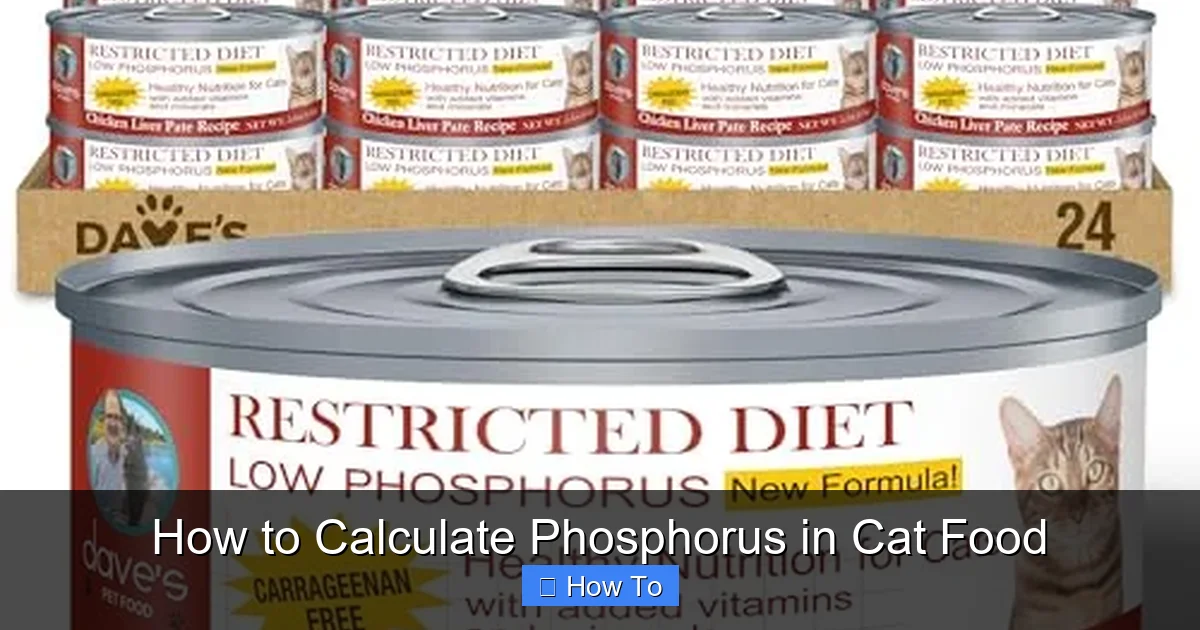
Visual guide about How to Calculate Phosphorus in Cat Food
Image source: m.media-amazon.com
Example:
– Wet food: 100% – 78% = 22% dry matter
– Dry food: 100% – 10% = 90% dry matter
Step 3: Find the As-Fed Phosphorus Percentage
This is the phosphorus value listed in the guaranteed analysis. It’s usually labeled as “Phosphorus (min)” or “Phosphorus (max).”
Example:
– Wet food: 0.8% phosphorus (as-fed)
– Dry food: 1.0% phosphorus (as-fed)
Step 4: Use the Dry Matter Conversion Formula
Now apply this formula to convert as-fed phosphorus to dry matter phosphorus:
Dry Matter Phosphorus (%) = (As-Fed Phosphorus ÷ Dry Matter %) × 100
Let’s plug in the numbers.
For the wet food:
(0.8 ÷ 22) × 100 = 3.64%
For the dry food:
(1.0 ÷ 90) × 100 = 1.11%
So even though the dry food had a higher as-fed phosphorus value, the wet food actually has more phosphorus on a dry matter basis—over three times as much!
This is why conversion is so important. Without it, you might accidentally choose a food that’s too high in phosphorus for a cat with kidney issues.
Practical Example: Comparing Two Cat Foods
Let’s walk through a real-world comparison to make this even clearer.
Food A: Wet Food (Kidney Support Formula)
- Moisture: 75%
- Phosphorus (as-fed): 0.6%
Food B: Dry Food (Standard Adult Formula)
- Moisture: 10%
- Phosphorus (as-fed): 1.2%
Now calculate dry matter phosphorus for both.
Food A:
– Dry matter % = 100 – 75 = 25%
– Dry matter phosphorus = (0.6 ÷ 25) × 100 = 2.4%
Food B:
– Dry matter % = 100 – 10 = 90%
– Dry matter phosphorus = (1.2 ÷ 90) × 100 = 1.33%
Surprising, right? The wet food—marketed for kidney support—has nearly double the phosphorus of the dry food when compared fairly.
This shows why label reading and calculation matter. Marketing claims don’t always reflect the actual nutritional profile.
What’s a Healthy Phosphorus Level for Cats?
Now that you know how to calculate phosphorus, what numbers should you aim for?
The ideal phosphorus level depends on your cat’s health status.
For Healthy Adult Cats
Most healthy cats do well with phosphorus levels between **0.6% and 1.2% on a dry matter basis**. This range supports normal growth, bone health, and metabolism without overloading the kidneys.
Many commercial adult cat foods fall within this range. Just remember to check the dry matter value, not the as-fed number.
For Cats with Kidney Disease
Veterinarians typically recommend **lower phosphorus intake** for cats with CKD. Target levels are usually:
– **Early-stage CKD:** Below 1.0% DMB
– **Moderate to advanced CKD:** Below 0.6% DMB
Some prescription kidney diets go even lower, around 0.3% to 0.5% DMB. These foods are formulated to reduce kidney workload and slow disease progression.
Always work with your vet to determine the best target for your cat. Blood tests can help monitor phosphorus levels and guide dietary adjustments.
For Kittens and Pregnant Cats
Growing kittens and pregnant/nursing cats need more phosphorus for bone development and milk production. Levels up to 1.5% DMB may be appropriate, but consult your vet before making changes.
Tips for Accurate Phosphorus Calculation
To get the most accurate results, keep these tips in mind:
1. Always Use the Guaranteed Analysis
Don’t rely on marketing claims like “low phosphorus” or “kidney-friendly.” These terms aren’t strictly regulated. Only the guaranteed analysis gives you measurable data.
2. Check for Minimum vs. Maximum Values
Phosphorus is often listed as a “minimum” percentage. This means the food contains *at least* that amount—it could be higher. For kidney diets, look for brands that specify a maximum or provide a range.
3. Contact the Manufacturer if Needed
If phosphorus isn’t listed, email or call the company. Most reputable brands will provide the information. You can also check their website or ask your vet for help.
4. Use Online Calculators (But Verify)
Some pet nutrition websites offer dry matter calculators. These can save time, but always double-check the math yourself to avoid errors.
5. Keep a Food Journal
Track the foods you feed, their phosphorus levels (DMB), and any changes in your cat’s health. This helps you and your vet spot patterns over time.
Troubleshooting Common Issues
Even with the right steps, you might run into challenges. Here’s how to handle common problems.
Problem: Phosphorus Not Listed on the Label
Not all brands disclose phosphorus. This is more common with budget or store-brand foods.
Solution: Contact the manufacturer. If they can’t provide the data, consider choosing a brand that’s more transparent. Your cat’s health is worth the extra effort.
Problem: Conflicting Information Online
Some websites list phosphorus values for popular foods, but numbers can vary by batch or formulation.
Solution: Always refer to the label on the product you’re buying. Formulas change, so don’t rely on outdated online data.
Problem: Homemade or Raw Diets
Homemade meals often lack complete nutritional analysis. Phosphorus content depends heavily on ingredients like meat, bones, and supplements.
Solution: Work with a veterinary nutritionist to formulate balanced recipes. They can calculate phosphorus and other nutrients to ensure your cat gets what they need.
Problem: Your Cat Refuses Low-Phosphorus Food
Some cats are picky eaters, especially when switching to a prescription diet.
Solution: Try mixing the new food with the old gradually. Warming wet food slightly can enhance aroma and appeal. Ask your vet about appetite stimulants if needed.
How to Choose the Right Cat Food Based on Phosphorus
Once you can calculate phosphorus, use that knowledge to make better choices.
For General Health
Choose a high-quality commercial food with phosphorus between 0.6% and 1.2% DMB. Look for whole protein sources (like chicken or turkey) and avoid fillers.
For Kidney Support
Opt for prescription kidney diets from brands like Hill’s Prescription Diet k/d, Royal Canin Renal, or Purina Pro Plan NF. These are scientifically formulated to support kidney function.
For Senior Cats
Older cats are at higher risk for kidney disease. Even if they’re healthy now, consider a senior formula with moderate phosphorus levels (around 0.8–1.0% DMB).
For Multi-Cat Households
If you have both healthy cats and cats with kidney issues, feeding the same food can be tricky. Talk to your vet about options like:
– Feeding separate meals
– Using a moderate-phosphorus food that works for both
– Adding phosphate binders (under veterinary supervision)
Final Thoughts: Empowering Your Cat’s Health
Calculating phosphorus in cat food might seem technical at first, but it’s a skill that pays off in better health and longer life for your cat. By learning to read labels, convert values, and understand what those numbers mean, you’re taking an active role in your pet’s well-being.
Remember, this isn’t about perfection—it’s about awareness. Small changes in diet can have a big impact, especially for cats with health challenges.
Always consult your veterinarian before making major dietary changes. They can help you interpret your cat’s lab results, set phosphorus goals, and choose the best food for their unique needs.
With the tools in this guide, you’re now equipped to make informed, confident decisions about your cat’s nutrition. Your furry friend deserves nothing less.