

Understanding how to determine carbohydrates in cat food is essential for feeding your cat a balanced, species-appropriate diet. This guide walks you through reading labels, calculating carb content, and making informed choices—even when brands don’t list carbs directly.
Key Takeaways
- Carbohydrates aren’t listed directly on pet food labels: You’ll need to calculate them using the guaranteed analysis and ingredient list.
- Use the “carb calculation formula”: Subtract protein, fat, moisture, ash, and fiber from 100% to estimate carbohydrate content.
- Look for hidden carb sources: Ingredients like corn, rice, potatoes, and peas can significantly increase carb levels.
- Wet food typically has fewer carbs than dry food: The higher moisture content dilutes carbohydrate concentration.
- Choose high-protein, low-carb diets for optimal feline health: Cats are obligate carnivores and thrive on meat-based nutrition.
- Third-party testing and AAFCO statements matter: They help verify nutritional claims and ensure quality.
- Consult your veterinarian before making major diet changes: Especially for cats with diabetes or obesity.
How to Determine Carbohydrates in Cat Food
If you’re a cat parent in 2026, you’ve probably noticed that pet food labels don’t list carbohydrate content directly. Unlike human nutrition labels, which clearly show grams of carbs per serving, cat food packaging often leaves you guessing. But here’s the good news: with a little know-how, you can estimate the carbohydrate content in your cat’s food—and make smarter, healthier choices.
In this guide, you’ll learn exactly how to determine carbohydrates in cat food using simple calculations, label reading skills, and a bit of ingredient detective work. Whether you’re feeding kibble, canned food, or raw diets, these steps will help you understand what’s really in your cat’s bowl.
We’ll cover everything from decoding the guaranteed analysis to spotting hidden carb sources, comparing wet vs. dry food, and even troubleshooting common mistakes. By the end, you’ll be confident in choosing a diet that supports your cat’s natural biology—because cats are obligate carnivores, and their bodies are built for meat, not grains.
Let’s dive in.
Why Carbohydrate Content Matters for Cats
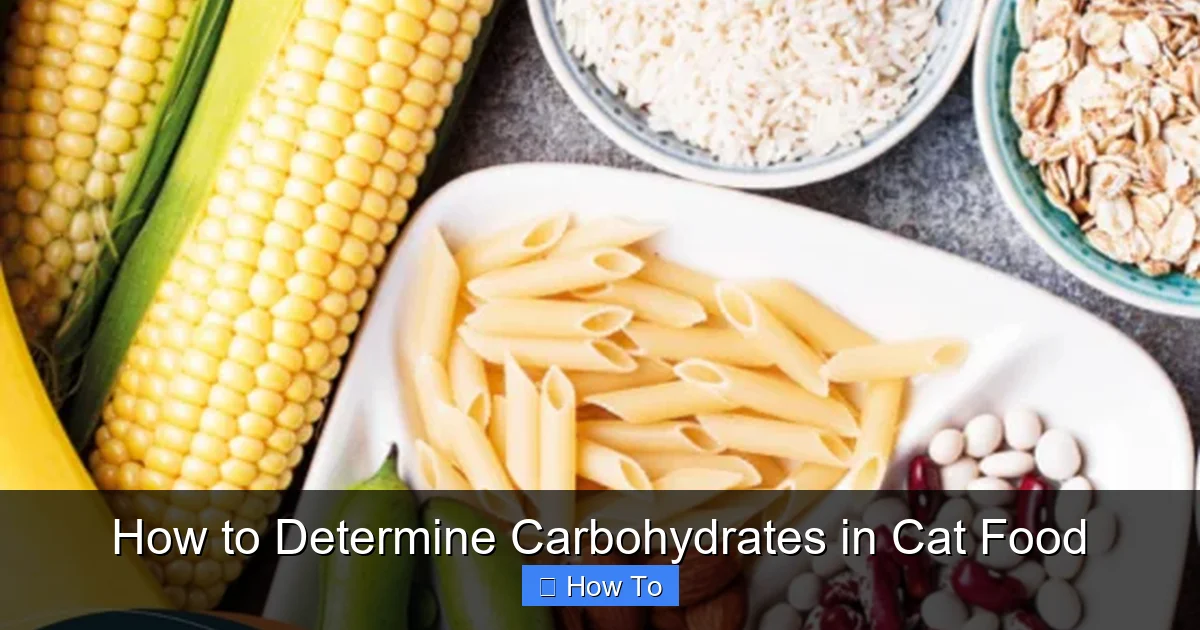
Visual guide about How to Determine Carbohydrates in Cat Food
Image source: en.allpetfood.net
Before we get into the how-to, let’s talk about why this matters. Cats are not built to process large amounts of carbohydrates. Unlike dogs or humans, their digestive systems lack certain enzymes needed to efficiently break down and use carbs for energy. In the wild, a cat’s diet consists almost entirely of animal protein and fat, with minimal plant matter.
When cats eat too many carbs, especially from low-quality sources like corn syrup or potato starch, it can lead to weight gain, insulin resistance, and even diabetes. Studies from 2024 and 2025 have shown that cats on high-carb diets are more likely to develop obesity and related health issues.
That doesn’t mean carbs are “bad” in all forms—some fiber from vegetables can support digestion—but the key is balance. Most veterinarians and feline nutrition experts recommend that carbohydrates make up no more than 10% of a cat’s daily caloric intake. For many commercial dry foods, that number can be 30% or higher.
So, knowing how to determine carbohydrates in cat food isn’t just a nice-to-have skill—it’s a crucial part of keeping your cat healthy, active, and thriving in 2026 and beyond.
Step 1: Understand the Pet Food Label
The first step in determining carbohydrates is learning how to read a pet food label. In the U.S., pet food labels are regulated by the Association of American Feed Control Officials (AAFCO), which sets standards for ingredient listing and nutritional guarantees.
Every cat food package includes a “Guaranteed Analysis” section. This lists the minimum percentages of crude protein and fat, and the maximum percentages of crude fiber and moisture. However, it does not include carbohydrates.
Here’s what you’ll typically see:
- Crude Protein (min): Usually 25–40%
- Crude Fat (min): Usually 10–20%
- Crude Fiber (max): Usually 1–5%
- Moisture (max): Usually 10% for dry food, 78% for wet food
You might also see “ash” listed, which refers to the mineral content left after burning the food. Ash typically ranges from 5% to 8%.
These numbers are the foundation for calculating carbohydrates. But first, let’s look at the ingredient list.
Read the Ingredient List Carefully
Ingredients are listed in order by weight. The first few ingredients make up the bulk of the food. If you see grains, starches, or plant-based fillers near the top, that’s a red flag for high carbohydrate content.
Common high-carb ingredients include:
- Corn (including corn gluten meal, corn starch)
- Rice (white, brown, or brewers rice)
- Wheat (including wheat gluten, wheat flour)
- Potatoes (including potato starch, dehydrated potatoes)
- Peas, lentils, and other legumes
- Soy products (soybean meal, soy flour)
- Oats, barley, and other grains
Even ingredients labeled as “healthy” or “natural” can be high in carbs. For example, sweet potatoes are nutritious but still contribute significant carbohydrates.
Look for foods where animal proteins—like chicken, turkey, fish, or eggs—are the first two or three ingredients. This suggests a higher meat content and lower reliance on plant fillers.
Step 2: Use the Carbohydrate Calculation Formula
Since carbs aren’t listed, you’ll need to calculate them using the guaranteed analysis. The formula is simple:
Carbohydrates (%) = 100% – (Protein % + Fat % + Moisture % + Ash % + Fiber %)
Let’s break this down with an example.
Example: Dry Cat Food Label
Suppose you have a dry cat food with the following guaranteed analysis:
- Crude Protein: 32% (min)
- Crude Fat: 14% (min)
- Crude Fiber: 4% (max)
- Moisture: 10% (max)
- Ash: 7% (typical estimate if not listed)
Note: Ash isn’t always listed, but most dry foods contain around 6–8% ash. If it’s not on the label, use 7% as a reasonable average.
Now plug the numbers into the formula:
Carbs = 100 – (32 + 14 + 10 + 7 + 4)
Carbs = 100 – 67
Carbs = 33%
So, this food contains approximately 33% carbohydrates. That’s quite high for a cat’s diet.
Example: Wet Cat Food Label
Now let’s try a wet food:
- Crude Protein: 10% (min)
- Crude Fat: 7% (min)
- Crude Fiber: 1.5% (max)
- Moisture: 78% (max)
- Ash: 2% (estimate)
Carbs = 100 – (10 + 7 + 78 + 2 + 1.5)
Carbs = 100 – 98.5
Carbs = 1.5%
Wait—that seems too low. What’s going on?
Ah, here’s the catch: the percentages on wet food labels are calculated on an “as-fed” basis, which includes all that moisture. To compare wet and dry foods fairly, we need to convert to a “dry matter basis.”
Step 3: Convert to Dry Matter Basis (DMB)
Comparing wet and dry foods directly using the as-fed percentages is misleading because wet food is mostly water. To get a true comparison, we convert everything to a dry matter basis—removing the moisture.
Here’s how to do it:
Step 1: Calculate Dry Matter
Dry Matter (%) = 100% – Moisture %
For the wet food example:
Dry Matter = 100 – 78 = 22%
Step 2: Calculate Each Nutrient on Dry Matter Basis
Use this formula:
Nutrient (DMB) = (Nutrient % as-fed ÷ Dry Matter %) × 100
Let’s calculate protein, fat, fiber, and ash on DMB:
- Protein (DMB) = (10 ÷ 22) × 100 = 45.5%
- Fat (DMB) = (7 ÷ 22) × 100 = 31.8%
- Fiber (DMB) = (1.5 ÷ 22) × 100 = 6.8%
- Ash (DMB) = (2 ÷ 22) × 100 = 9.1%
Now, calculate carbohydrates on dry matter basis:
Carbs (DMB) = 100 – (45.5 + 31.8 + 6.8 + 9.1)
Carbs (DMB) = 100 – 93.2
Carbs (DMB) = 6.8%
So, even though the wet food appeared to have only 1.5% carbs on the label, it actually contains about 6.8% carbs when adjusted for moisture. That’s much more reasonable—and comparable to many high-quality dry foods.
This is why converting to dry matter basis is essential for accurate comparisons.
Step 4: Compare Wet vs. Dry Food Carb Content
Now that you know how to calculate carbs on a dry matter basis, let’s compare typical values.
Typical Carbohydrate Levels (Dry Matter Basis)
- High-quality wet food: 5–10% carbs
- High-quality dry food: 15–25% carbs
- Economy dry food: 30–50% carbs
- Raw or homemade diets: 0–5% carbs (depending on recipe)
As you can see, wet food generally has fewer carbohydrates than dry food. This is because dry kibble requires starches to hold its shape during extrusion. Those starches—like corn, rice, or potato—add up quickly.
For example, a popular dry food might list “chicken” first, but if the next three ingredients are “brown rice,” “peas,” and “potato protein,” the carb content could still be high.
Wet food, on the other hand, can be made with minimal processing and fewer binding agents, allowing for lower carb formulations.
Practical Tip: Look for “Grain-Free” and “Low-Carb” Labels
Many brands now market “grain-free” or “low-carb” cat foods. While “grain-free” doesn’t automatically mean low-carb (some use potatoes or peas instead), it’s often a step in the right direction.
Look for wet foods with simple ingredient lists: meat, broth, vitamins, and minerals. Avoid foods with added sugars, syrups, or excessive plant proteins.
Step 5: Spot Hidden Carbohydrate Sources
Even if a food appears low in carbs, some ingredients can sneak in extra starches. Here are common hidden carb sources to watch for:
- Potato starch or tapioca: Used as thickeners or binders in wet food.
- Pea fiber or lentil flour: Marketed as “high-fiber” but still contribute carbs.
- Beet pulp: A fiber source that can add moderate carbs.
- Dried eggs or liver: Usually fine, but check if they’re combined with starches.
- Flavor enhancers like “broth” or “gravy”: May contain added sugars or thickeners.
Always read the full ingredient list—not just the front label. Marketing terms like “natural,” “holistic,” or “premium” don’t guarantee low carbs.
Step 6: Use Online Tools and Apps (2026 Edition)
In 2026, technology makes it easier than ever to analyze pet food. Several apps and websites now allow you to scan barcodes or search brand names to get detailed nutritional breakdowns—including estimated carbohydrate content.
Popular tools include:
- PetFoodDB (2026 version): A comprehensive database with dry matter calculations and ingredient analysis.
- CatFoodAnalyzer by VetNutri: An AI-powered tool that estimates carbs, compares brands, and flags high-risk ingredients.
- Barcode scanners in pet store apps: Many retailers now provide nutritional summaries when you scan a product.
These tools can save time and reduce calculation errors. However, always double-check with the manufacturer’s website or contact customer service if you’re unsure.
Step 7: Consider Your Cat’s Individual Needs
Not all cats need ultra-low-carb diets. Healthy adult cats can tolerate moderate carbs, especially if they’re active. But certain conditions require stricter control:
- Diabetic cats: Need very low-carb diets to manage blood sugar.
- Obese cats: Benefit from reduced calorie and carb intake.
- Senior cats with kidney issues: May need lower phosphorus, but carb content should still be monitored.
- Kittens: Need high protein and fat, but can handle slightly more carbs for energy.
Always consult your veterinarian before switching diets, especially for medical conditions.
Troubleshooting Common Mistakes
Even experienced cat owners can make errors when calculating carbs. Here are common pitfalls and how to avoid them:
Mistake 1: Forgetting to Convert to Dry Matter Basis
Comparing wet and dry food using as-fed percentages will give wildly inaccurate results. Always convert to dry matter basis for fair comparisons.
Mistake 2: Ignoring Ash Content
Ash isn’t always listed, but it’s a significant portion of the food. Assuming 7% for dry food and 2–3% for wet food is a safe estimate.
Mistake 3: Overlooking Fiber
Fiber is a type of carbohydrate, but it’s not digestible. Still, it counts in the calculation. Don’t skip it.
Mistake 4: Trusting Marketing Claims
“Grain-free” doesn’t mean low-carb. “High-protein” doesn’t guarantee low carbs. Always check the math.
Mistake 5: Not Updating Calculations for New Formulas
Pet food recipes change. A brand you’ve used for years might reformulate. Recheck labels periodically.
Conclusion: Make Informed Choices for Your Cat
Determining carbohydrates in cat food doesn’t have to be complicated. With the right tools and a little practice, you can decode labels, calculate percentages, and choose diets that align with your cat’s natural needs.
Remember: cats thrive on high-protein, low-carb nutrition. By learning how to determine carbohydrates in cat food, you’re taking a proactive step toward better health, longer life, and fewer vet visits.
Start by reading labels, using the carb calculation formula, and converting to dry matter basis. Use technology to your advantage, and don’t hesitate to ask your vet for guidance.
In 2026, pet nutrition is more transparent than ever—but it still takes a watchful eye. Your cat depends on you to make the best choices. Now you have the knowledge to do just that.