
Understanding the dry matter basis of cat food helps you compare nutritional content across wet, dry, and semi-moist foods fairly. This guide walks you through simple steps to convert as-fed values into dry matter values, so you can choose the best diet for your feline friend.
Key Takeaways
- Why it matters: Dry matter basis removes water content, allowing accurate comparison of protein, fat, and carbs across different food types.
- Simple formula: Use (Nutrient % ÷ Dry Matter %) × 100 to calculate any nutrient on a dry matter basis.
- Find moisture content: Check the guaranteed analysis on the pet food label—it lists moisture percentage.
- Dry matter = 100% – moisture %: This gives you the total dry portion of the food.
- Wet food isn’t “less nutritious”: High moisture hides nutrient density—dry matter basis reveals the real numbers.
- Use it for all diets: Whether raw, canned, kibble, or homemade, dry matter basis ensures fair comparisons.
- Better decisions for your cat: Knowing dry matter values helps you meet your cat’s unique nutritional needs.
How to Calculate Dry Matter Basis of Cat Food
If you’ve ever compared cat food labels, you’ve probably noticed something confusing: wet food often lists lower protein percentages than dry food. But does that mean dry food is better? Not necessarily. The difference often comes down to water content. That’s where understanding the dry matter basis of cat food becomes essential.
In this guide, you’ll learn exactly what dry matter basis means, why it matters for your cat’s health, and—most importantly—how to calculate it yourself using simple math and information from any pet food label. Whether you’re choosing between canned tuna and kibble, evaluating a raw diet, or just trying to understand what’s really in your cat’s bowl, mastering dry matter calculations puts you in control.
By the end of this guide, you’ll be able to:
– Read and interpret pet food labels like a pro
– Convert “as-fed” nutrient values to dry matter basis
– Compare different types of cat food fairly
– Make informed decisions based on your cat’s dietary needs
Let’s dive in.
What Is Dry Matter Basis?
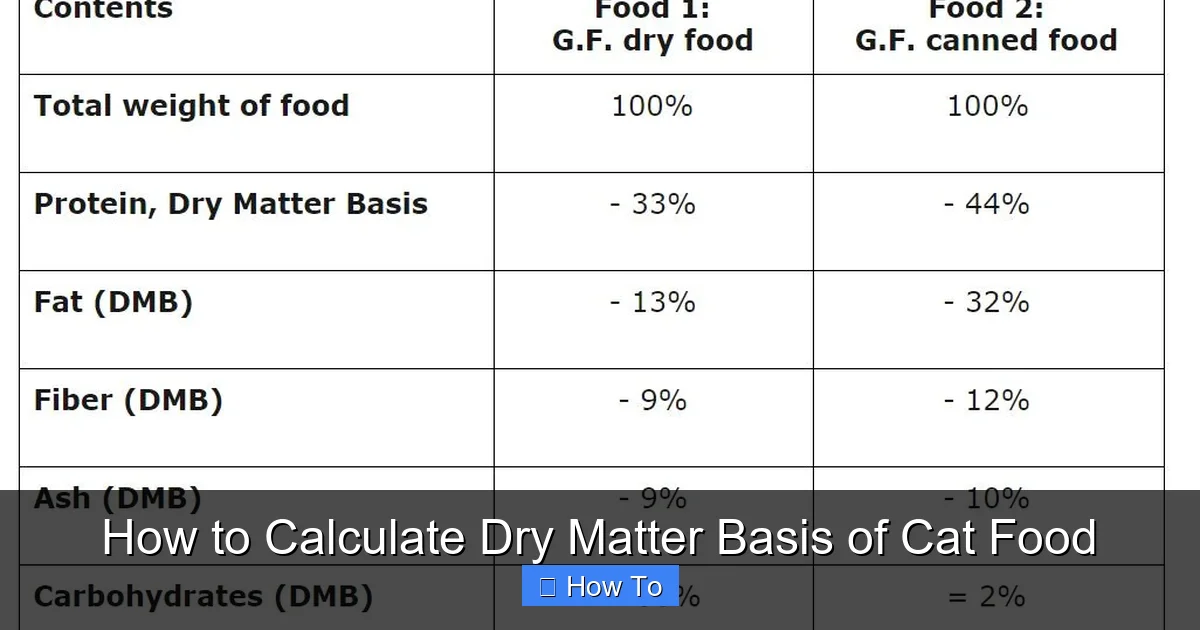
Visual guide about How to Calculate Dry Matter Basis of Cat Food
Image source: thecatsite.com
Before we get into calculations, let’s clarify what “dry matter basis” actually means.
Pet food labels list nutrients like protein, fat, fiber, and moisture as percentages—but these are measured “as-fed.” That means they include everything in the food as it’s packaged: water, oils, proteins, carbohydrates, and more.
The problem? Water makes up a huge portion of many cat foods—especially wet or canned varieties. A can of wet food might be 75–80% water. So when the label says “10% protein,” that 10% is out of the total weight, including all that water. In reality, the protein concentration in the solid portion is much higher.
Dry matter basis removes the water. It tells you what percentage of the food’s solid (dry) components are made up of protein, fat, fiber, etc. This allows you to compare foods with different moisture levels on equal footing.
Think of it like comparing juice to fruit. A glass of orange juice might have 10% sugar by volume, but a whole orange has far less sugar relative to its total weight—because the orange includes fiber, water, and other solids. If you only looked at the juice, you’d overestimate the sugar content. Similarly, looking only at “as-fed” values can mislead you about a cat food’s true nutritional density.
Why Should You Care About Dry Matter Basis?
You might be wondering: “Isn’t the guaranteed analysis enough?” Not quite.
Cats are obligate carnivores. They need high levels of animal-based protein and moderate fat, with minimal carbohydrates. But because pet food labels don’t standardize moisture content, two foods with very different formulations can look similar—or vice versa—on paper.
For example:
– A dry kibble might list 35% protein (as-fed) with 10% moisture.
– A wet food might list 10% protein (as-fed) with 78% moisture.
At first glance, the kibble seems far superior. But when you convert both to dry matter basis, the wet food might actually have 45% protein—higher than the kibble’s 38.9%.
Without dry matter calculations, you could accidentally choose a lower-protein food thinking it’s better—or dismiss a high-quality wet food because the numbers look low.
Additionally, many veterinarians and pet nutritionists recommend feeding wet food to support urinary health and hydration. But if you’re trying to ensure your cat gets enough protein, you need to know the real numbers—not just the as-fed percentages.
Dry matter basis gives you that clarity.
Step-by-Step Guide to Calculating Dry Matter Basis
Now for the practical part: how to calculate dry matter basis yourself. Don’t worry—it’s easier than it sounds. You only need:
– The pet food label (specifically the guaranteed analysis)
– A calculator (or your phone)
– Basic math skills
We’ll walk through each step with real-world examples.
Step 1: Find the Moisture Percentage
Look at the guaranteed analysis on the back or side of the cat food packaging. It’s usually a small box listing percentages for:
– Crude protein
– Crude fat
– Crude fiber
– Moisture
Find the moisture percentage. This is key.
For example:
– Dry food: 10% moisture
– Wet food: 78% moisture
– Raw food: 65% moisture
Write this number down.
Step 2: Calculate the Dry Matter Percentage
Dry matter is everything in the food except water. So:
Dry Matter % = 100% – Moisture %
Let’s use our examples:
– Dry food: 100 – 10 = 90% dry matter
– Wet food: 100 – 78 = 22% dry matter
– Raw food: 100 – 65 = 35% dry matter
This means that in a can of wet food, only 22% of the weight is actual food solids—the rest is water. But those 22% contain all the nutrients.
Step 3: Choose the Nutrient You Want to Convert
You can convert any nutrient: protein, fat, fiber, ash, or carbohydrates (though carbs aren’t listed directly—we’ll cover that later).
Let’s focus on protein first, since it’s the most important for cats.
Find the crude protein percentage in the guaranteed analysis. This is the “as-fed” value.
Examples:
– Dry food: 35% protein (as-fed)
– Wet food: 10% protein (as-fed)
– Raw food: 12% protein (as-fed)
Step 4: Apply the Dry Matter Formula
Here’s the magic formula:
Nutrient (Dry Matter Basis) = (Nutrient % ÷ Dry Matter %) × 100
Let’s plug in the numbers.
For the dry food:
– Protein (as-fed): 35%
– Dry matter: 90%
– Calculation: (35 ÷ 90) × 100 = 38.9%
So, the protein on a dry matter basis is 38.9%.
For the wet food:
– Protein (as-fed): 10%
– Dry matter: 22%
– Calculation: (10 ÷ 22) × 100 = 45.5%
The wet food has 45.5% protein on a dry matter basis—higher than the dry food!
For the raw food:
– Protein (as-fed): 12%
– Dry matter: 35%
– Calculation: (12 ÷ 35) × 100 = 34.3%
So the raw food has 34.3% protein on dry matter basis.
Now you can see: the wet food is actually the highest in protein, despite its low as-fed number.
Step 5: Repeat for Other Nutrients (Optional)
You can use the same formula for fat, fiber, or any other nutrient.
Example: Fat in the wet food
– Fat (as-fed): 5%
– Dry matter: 22%
– Calculation: (5 ÷ 22) × 100 = 22.7% fat (dry matter basis)
Compare that to the dry food:
– Fat (as-fed): 15%
– Dry matter: 90%
– Calculation: (15 ÷ 90) × 100 = 16.7% fat (dry matter basis)
Now the wet food looks higher in fat too—but remember, cats need moderate fat, not excessive amounts.
Real-World Example: Comparing Two Cat Foods
Let’s put this into practice with two real products.
Food A: Premium Dry Kibble
– Protein: 34%
– Fat: 14%
– Fiber: 3%
– Moisture: 10%
Food B: High-End Wet Food
– Protein: 11%
– Fat: 6%
– Fiber: 1.5%
– Moisture: 78%
At first glance, Food A seems better: higher protein, higher fat. But let’s calculate dry matter basis.
Step 1: Dry Matter %
– Food A: 100 – 10 = 90%
– Food B: 100 – 78 = 22%
Step 2: Protein (Dry Matter Basis)
– Food A: (34 ÷ 90) × 100 = 37.8%
– Food B: (11 ÷ 22) × 100 = 50%
Step 3: Fat (Dry Matter Basis)
– Food A: (14 ÷ 90) × 100 = 15.6%
– Food B: (6 ÷ 22) × 100 = 27.3%
Step 4: Fiber (Dry Matter Basis)
– Food A: (3 ÷ 90) × 100 = 3.3%
– Food B: (1.5 ÷ 22) × 100 = 6.8%
Now the picture changes. Food B has significantly higher protein and fat on a dry matter basis—ideal for a carnivore. But it also has more fiber, which may or may not be desirable depending on your cat.
This comparison shows why dry matter basis is so valuable. Without it, you might overlook a superior wet food.
How to Calculate Carbohydrates on Dry Matter Basis
Carbohydrates aren’t listed on pet food labels, but you can estimate them using the “nitrogen-free extract” method or by subtracting known components from 100%.
The formula is:
Carbohydrates (as-fed) ≈ 100% – (Protein % + Fat % + Fiber % + Ash % + Moisture %)
Note: Ash is the mineral content left after burning the food. It’s usually listed on the label.
Let’s use Food B (wet food) from our example:
– Protein: 11%
– Fat: 6%
– Fiber: 1.5%
– Ash: 2%
– Moisture: 78%
Calculation:
100 – (11 + 6 + 1.5 + 2 + 78) = 100 – 98.5 = 1.5% carbohydrates (as-fed)
Now convert to dry matter basis:
– Dry matter: 22%
– Carbs (as-fed): 1.5%
– Carbs (dry matter): (1.5 ÷ 22) × 100 = 6.8%
So, even on dry matter basis, this wet food is low in carbs—great for cats.
Compare to Food A (dry kibble):
– Protein: 34%
– Fat: 14%
– Fiber: 3%
– Ash: 8%
– Moisture: 10%
– Carbs (as-fed): 100 – (34 + 14 + 3 + 8 + 10) = 31%
– Dry matter: 90%
– Carbs (dry matter): (31 ÷ 90) × 100 = 34.4%
That’s over a third carbohydrates—much higher than ideal for a cat.
This is a powerful insight. Many dry foods are high in carbs due to grains, potatoes, or other fillers. Dry matter basis reveals this hidden issue.
Common Mistakes to Avoid
Even with the right formula, it’s easy to make errors. Here are common pitfalls and how to avoid them.
Mistake 1: Forgetting to Subtract Moisture
Some people try to calculate dry matter basis using the as-fed dry matter percentage without subtracting moisture first. But dry matter % is always 100 – moisture %. Don’t skip this step.
Mistake 2: Using the Wrong Nutrient Value
Make sure you’re using the “crude” values from the guaranteed analysis—not marketing claims like “made with real chicken.” Only the guaranteed analysis is standardized.
Mistake 3: Ignoring Ash
When calculating carbs, ash is often overlooked. But it’s part of the total composition. Leaving it out inflates the carb estimate.
Mistake 4: Comparing Without Dry Matter Basis
Never compare as-fed values across different moisture levels. Always convert to dry matter basis first.
Mistake 5: Assuming Higher Protein Is Always Better
While cats need high protein, excessively high levels (especially from plant sources) may not be ideal. Also, senior or kidney-compromised cats may need lower protein. Always consider your cat’s health.
Tips for Using Dry Matter Basis in Real Life
Now that you know how to calculate it, here’s how to apply it daily.
Tip 1: Create a Comparison Chart
Make a simple table with columns for:
– Food name
– Moisture %
– Dry matter %
– Protein (as-fed)
– Protein (dry matter)
– Fat (dry matter)
– Carbs (dry matter)
Fill it out for all the foods you’re considering. Visual comparisons make decisions easier.
Tip 2: Prioritize Protein and Moisture
For most cats, aim for:
– Protein (dry matter): 40–50% or higher
– Fat (dry matter): 15–25%
– Carbs (dry matter): under 10% (ideally under 5%)
– Moisture: 70–80% for wet food (supports hydration)
Use dry matter basis to find foods that meet these goals.
Tip 3: Don’t Fear Wet Food
Many owners avoid wet food because the protein looks “low.” But as we’ve seen, wet food often has higher protein on dry matter basis. Plus, it’s better for hydration and urinary health.
Tip 4: Use Online Calculators (But Verify)
Some websites offer dry matter calculators. They can save time, but always double-check the math. Labels change, and not all calculators are updated.
Tip 5: Consult Your Vet
If your cat has special needs—kidney disease, diabetes, obesity—talk to your veterinarian before making major diet changes. Dry matter basis is a tool, not a replacement for professional advice.
Troubleshooting Common Questions
What if the Label Doesn’t List Ash?
Ash isn’t always listed, especially on smaller brands. If it’s missing, you can estimate carbs by subtracting only the known values. But note: your carb estimate will be slightly high. For rough comparisons, it’s still useful.
Can I Use This for Homemade or Raw Diets?
Yes! If you’re feeding raw or homemade food, you can send a sample to a lab for analysis, or use nutritional databases (like NRC or USDA) to estimate values. Then apply the same dry matter formula.
Does Dry Matter Basis Change Over Time?
No. Dry matter basis is a calculation based on the food’s composition. It doesn’t change unless the recipe changes. But always check new batches—brands sometimes reformulate.
Is Dry Matter Basis the Same as “Guaranteed Analysis”?
No. Guaranteed analysis shows as-fed values. Dry matter basis is a derived value that removes water. They serve different purposes.
Why This Matters for Your Cat’s Health
Cats thrive on high-protein, low-carb, moisture-rich diets. But the pet food industry doesn’t always make it easy to find these foods. Marketing claims, confusing labels, and varying moisture levels can mislead even careful owners.
By learning how to calculate dry matter basis, you cut through the noise. You gain the ability to:
– Identify truly high-protein foods
– Avoid hidden carbohydrates
– Compare wet and dry foods fairly
– Support your cat’s natural dietary needs
This knowledge empowers you to make choices based on science, not slogans.
And the best part? It only takes a few minutes per food. Once you’ve done it a few times, it becomes second nature.
Final Thoughts
Calculating the dry matter basis of cat food isn’t just for nutritionists or veterinarians—it’s a practical skill every cat owner should have. It transforms confusing labels into clear, comparable data. It helps you see beyond moisture and marketing to the real nutritional value inside.
You don’t need a degree in animal science. You just need the formula, a label, and a little patience.
Start today. Pick two cat foods—one wet, one dry—and calculate their protein on dry matter basis. You might be surprised by what you discover.
Your cat deserves the best. And now, you have the tools to give it to them.