
Understanding how to calculate dry matter basis for cat food helps you make smarter, healthier choices for your feline friend. This guide breaks down the process into simple steps, so you can compare wet and dry foods fairly and choose the best diet based on actual nutrition—not water content.
Key Takeaways
- Why dry matter basis matters: It removes water content from the equation, letting you compare the true nutritional value of wet and dry cat foods.
- Simple math is all it takes: You only need two numbers—crude protein percentage and moisture percentage—to calculate dry matter basis.
- Wet food isn’t always lower in carbs: When adjusted to dry matter basis, some wet foods may have similar or higher carbohydrate levels than dry kibble.
- Protein quality varies: Dry matter protein percentages help reveal if a food meets your cat’s needs, especially for obligate carnivores.
- Use online calculators as a backup: While manual calculation is easy, digital tools can help double-check your work.
- Always read labels carefully: Moisture and guaranteed analysis sections on packaging are essential for accurate calculations.
- Consult your vet: Use dry matter analysis as a tool, but always discuss dietary changes with a veterinarian.
How to Calculate Dry Matter Basis for Cat Food
If you’ve ever compared cat food labels, you’ve probably noticed something confusing: wet food often lists lower protein percentages than dry food. But that doesn’t mean it’s less nutritious. The difference comes down to water—lots of it. Wet food can be up to 80% water, while dry food is only about 10%. That’s why learning how to calculate dry matter basis for cat food is so important. It levels the playing field, letting you compare foods based on their actual nutritional content, not just what’s listed on the label.
In this guide, we’ll walk you through everything you need to know about dry matter basis (DMB). You’ll learn why it matters, how to do the math step by step, and how to use this knowledge to choose the best food for your cat. Whether you’re feeding kibble, canned food, raw, or homemade meals, understanding DMB gives you the power to make informed decisions.
By the end of this article, you’ll be able to confidently compare any two cat foods—wet or dry—and understand which one offers more protein, fat, or carbohydrates on a true nutritional basis. No more guessing. No more confusion. Just clear, science-backed insight.
What Is Dry Matter Basis?
Before we dive into calculations, let’s clarify what “dry matter basis” actually means. In simple terms, dry matter basis is a way of expressing the nutrient content of food as if all the water were removed. This allows for a fair comparison between foods with different moisture levels.
For example, a can of wet food might list 10% protein, while a bag of dry food lists 35% protein. At first glance, dry food seems much higher in protein. But when you account for moisture—say, 78% in the wet food and 10% in the dry—the real protein content tells a different story. On a dry matter basis, the wet food might actually have 45% protein, making it more protein-rich than the dry option.
Why does this matter for cats? Because cats are obligate carnivores. They need a diet high in animal-based protein and low in carbohydrates. Water content doesn’t provide nutrition—it just fills space. By focusing on dry matter, you’re looking at what your cat actually digests and uses for energy, muscle maintenance, and overall health.
Why You Should Calculate Dry Matter Basis
You might be wondering: “Can’t I just trust the label?” Unfortunately, pet food labels aren’t always the most transparent. They list nutrients as “as-fed” percentages, which include water. This can be misleading, especially when comparing wet and dry foods.
Here are a few reasons why calculating dry matter basis is essential:
- Accurate comparisons: You can’t fairly compare a 10% protein wet food to a 35% protein dry food without adjusting for moisture. Dry matter basis fixes that.
- Better dietary choices: Cats thrive on high-protein, low-carb diets. Dry matter analysis helps you find foods that truly meet those needs.
- Spot hidden carbs: Some wet foods use fillers like grains or starches. When adjusted to dry matter, these can reveal unexpectedly high carbohydrate levels.
- Evaluate premium claims: Just because a food is expensive or labeled “premium” doesn’t mean it’s nutritionally superior. Dry matter analysis helps you verify claims.
- Support health goals: If your cat has diabetes, kidney disease, or obesity, precise nutrition matters. Dry matter calculations help tailor their diet effectively.
In short, dry matter basis is your secret weapon for cutting through marketing hype and making science-based feeding decisions.
Step-by-Step Guide to Calculating Dry Matter Basis
Now for the fun part—actually doing the math! Don’t worry, it’s simpler than it sounds. You only need two pieces of information from the pet food label: the nutrient percentage (like protein) and the moisture percentage. Here’s how to calculate dry matter basis in four easy steps.
Step 1: Find the Moisture Percentage
Look at the guaranteed analysis section on the back or side of the cat food packaging. You’ll see a line that says “Moisture – X%.” This is the amount of water in the food.
For example:
- Wet food: Moisture – 78%
- Dry food: Moisture – 10%
Write this number down. You’ll use it in the next step.
Step 2: Calculate the Dry Matter Percentage
Dry matter is everything in the food that isn’t water. To find it, subtract the moisture percentage from 100%.
Formula:
Dry Matter % = 100% – Moisture %

Visual guide about How to Calculate Dry Matter Basis for Cat Food
Image source: catcentric.org
Example:
- Wet food: 100% – 78% = 22% dry matter
- Dry food: 100% – 10% = 90% dry matter
This means that in every 100 grams of wet food, only 22 grams are actual food solids. The rest is water.
Step 3: Find the Nutrient Percentage (As-Fed)
Next, locate the nutrient you want to analyze—usually crude protein, but you can do this for fat, fiber, or carbohydrates too. This number is listed as a percentage in the guaranteed analysis.
For example:
- Wet food: Crude Protein – 10%
- Dry food: Crude Protein – 35%
This is the “as-fed” value, meaning it includes water.
Step 4: Calculate the Dry Matter Basis
Now, use this formula to convert the as-fed nutrient percentage to dry matter basis:
Dry Matter Basis (%) = (As-Fed Nutrient %) ÷ (Dry Matter %) × 100
Let’s apply it to our examples.
Wet Food Example:
- As-Fed Protein: 10%
- Moisture: 78%
- Dry Matter: 100% – 78% = 22%
- Dry Matter Basis = (10 ÷ 22) × 100 = 45.45%
So, the wet food has 45.45% protein on a dry matter basis.
Dry Food Example:
- As-Fed Protein: 35%
- Moisture: 10%
- Dry Matter: 100% – 10% = 90%
- Dry Matter Basis = (35 ÷ 90) × 100 = 38.89%
The dry food has 38.89% protein on a dry matter basis.
Even though the dry food listed a higher protein percentage (35% vs. 10%), the wet food actually has more protein when adjusted for moisture. That’s the power of dry matter basis!
How to Calculate Dry Matter Basis for Other Nutrients
Protein isn’t the only nutrient you can analyze. You can use the same method for fat, fiber, ash, and even estimate carbohydrates.
Calculating Fat on Dry Matter Basis
Let’s say a wet food has 5% fat and 78% moisture.
- Dry Matter = 100% – 78% = 22%
- Dry Matter Fat = (5 ÷ 22) × 100 = 22.73%
Compare that to a dry food with 15% fat and 10% moisture:
- Dry Matter = 90%
- Dry Matter Fat = (15 ÷ 90) × 100 = 16.67%
The wet food has more fat on a dry matter basis.
Estimating Carbohydrates
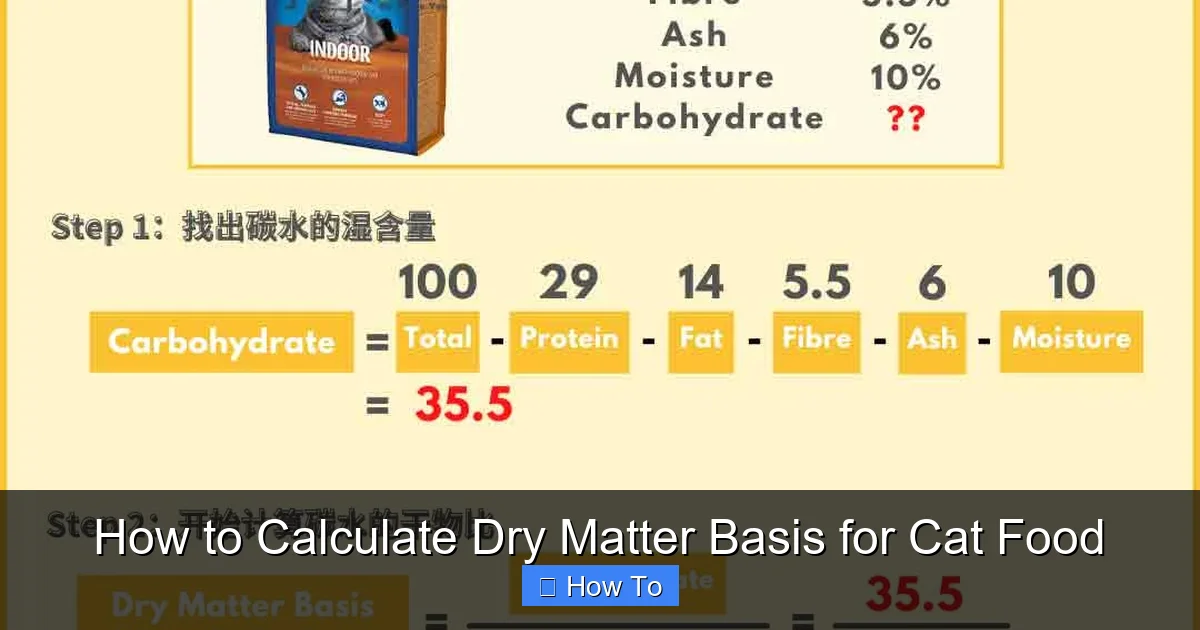
Pet food labels don’t always list carbohydrates directly, but you can estimate them using the “nitrogen-free extract” (NFE) method or by subtracting known components from 100%.
Formula:
Estimated Carbs % = 100% – (Protein % + Fat % + Fiber % + Ash % + Moisture %)
Example (wet food):
- Protein: 10%
- Fat: 5%
- Fiber: 1%
- Ash: 2%
- Moisture: 78%
- Estimated Carbs = 100 – (10 + 5 + 1 + 2 + 78) = 4%
Now convert to dry matter basis:
- Dry Matter = 22%
- Dry Matter Carbs = (4 ÷ 22) × 100 = 18.18%
This tells you that nearly 18% of the dry matter in this wet food is carbohydrates—something to consider if your cat needs a low-carb diet.
Practical Tips for Using Dry Matter Basis
Now that you know how to calculate dry matter basis, here are some practical tips to make the most of this knowledge.
Create a Comparison Chart
Make a simple table to compare multiple foods. List the brand, type (wet/dry), moisture, protein (as-fed), and protein (dry matter basis). This makes it easy to see which food offers the most protein.
Example:
| Brand | Type | Moisture | Protein (As-Fed) | Protein (DMB) |
|---|---|---|---|---|
| Tuna Delight | Wet | 78% | 10% | 45.5% |
| Chicken Kibble | Dry | 10% | 35% | 38.9% |
Focus on Protein First
For cats, protein is king. Aim for a dry matter protein level of at least 40–50% for adult cats, and even higher for kittens or active cats. Use dry matter basis to find foods that meet this threshold.
Watch Out for Hidden Carbs
Some wet foods use thickeners like rice flour, cornstarch, or potato. These can spike carbohydrate levels when adjusted to dry matter. Always check the ingredient list and calculate carbs if needed.
Use Online Calculators
If math isn’t your thing, use free online dry matter calculators. Just enter the moisture and nutrient percentages, and they’ll do the rest. Great for double-checking your work.
Keep a Food Journal
Track the foods you feed and their dry matter values. Over time, you’ll build a database of your cat’s favorites and their nutritional profiles.
Common Mistakes to Avoid
Even with the best intentions, it’s easy to make errors when calculating dry matter basis. Here are some common pitfalls and how to avoid them.
Using the Wrong Moisture Value
Always use the moisture percentage listed on the label. Don’t guess or assume. Different brands and even different flavors from the same brand can vary.
Forgetting to Convert All Nutrients
If you’re comparing protein, make sure you also convert fat and carbs to dry matter basis. A food might look high in protein but also high in fat or carbs.
Ignoring Ingredient Quality
Dry matter basis tells you the quantity of nutrients, not the quality. A food with 50% protein from plant sources isn’t as beneficial as one with 50% from animal meat. Always check the ingredient list.
Overlooking Ash Content
Ash is the mineral content left after burning food. High ash can indicate excess minerals, which may stress kidneys. Include it in your carb calculations.
Not Consulting a Vet
Dry matter analysis is a tool, not a replacement for professional advice. If your cat has health issues, talk to your vet before making dietary changes.
Troubleshooting Dry Matter Calculations
Sometimes, things don’t add up. Here’s how to handle common issues.
What If the Numbers Don’t Add Up?
If your estimated carbs are negative or over 100%, double-check your math. Make sure you’re using the correct percentages and that all values are from the same label.
What If Moisture Isn’t Listed?
All pet food labels in the U.S. must list moisture under the guaranteed analysis. If it’s missing, contact the manufacturer or avoid the product.
Can I Calculate Dry Matter for Homemade Food?
Yes! Use a food scale and nutritional database (like USDA FoodData Central) to find the moisture and nutrient content of each ingredient. Then calculate the total dry matter and nutrient percentages.
Does Dry Matter Basis Apply to Raw Food?
Absolutely. Raw diets often have high moisture content (around 60–70%). Use the same method to compare raw, cooked, and commercial foods fairly.
Real-World Example: Comparing Two Popular Cat Foods
Let’s put it all together with a real comparison.
Food A: Premium Wet Food
- Moisture: 75%
- Crude Protein: 12%
- Crude Fat: 6%
- Crude Fiber: 1%
- Ash: 2%
Food B: Budget Dry Food
- Moisture: 10%
- Crude Protein: 32%
- Crude Fat: 12%
- Crude Fiber: 4%
- Ash: 8%
Step 1: Calculate Dry Matter
- Food A: 100 – 75 = 25%
- Food B: 100 – 10 = 90%
Step 2: Calculate Protein (DMB)
- Food A: (12 ÷ 25) × 100 = 48%
- Food B: (32 ÷ 90) × 100 = 35.6%
Step 3: Estimate Carbs
- Food A: 100 – (12 + 6 + 1 + 2 + 75) = 4% → (4 ÷ 25) × 100 = 16% DMB
- Food B: 100 – (32 + 12 + 4 + 8 + 10) = 34% → (34 ÷ 90) × 100 = 37.8% DMB
Conclusion: The wet food has more protein and fewer carbs on a dry matter basis, making it a better choice for a carnivorous diet—even though it’s labeled as “premium” and the dry food is cheaper.
Conclusion
Learning how to calculate dry matter basis for cat food empowers you to cut through the noise and make truly informed decisions about your cat’s diet. It’s a simple yet powerful tool that reveals the real nutritional value behind the label. Whether you’re comparing wet and dry foods, evaluating premium brands, or managing a health condition, dry matter analysis gives you clarity and confidence.
Remember, the goal isn’t to find the “perfect” food—it’s to find the best fit for your cat’s individual needs. Use dry matter basis as a guide, but always consider ingredient quality, your cat’s age and health, and professional veterinary advice.
With this knowledge, you’re no longer at the mercy of marketing claims or misleading percentages. You’re in control. And your cat? They’ll thank you with better health, more energy, and a longer, happier life.
Start calculating today. Your feline friend deserves nothing less.