
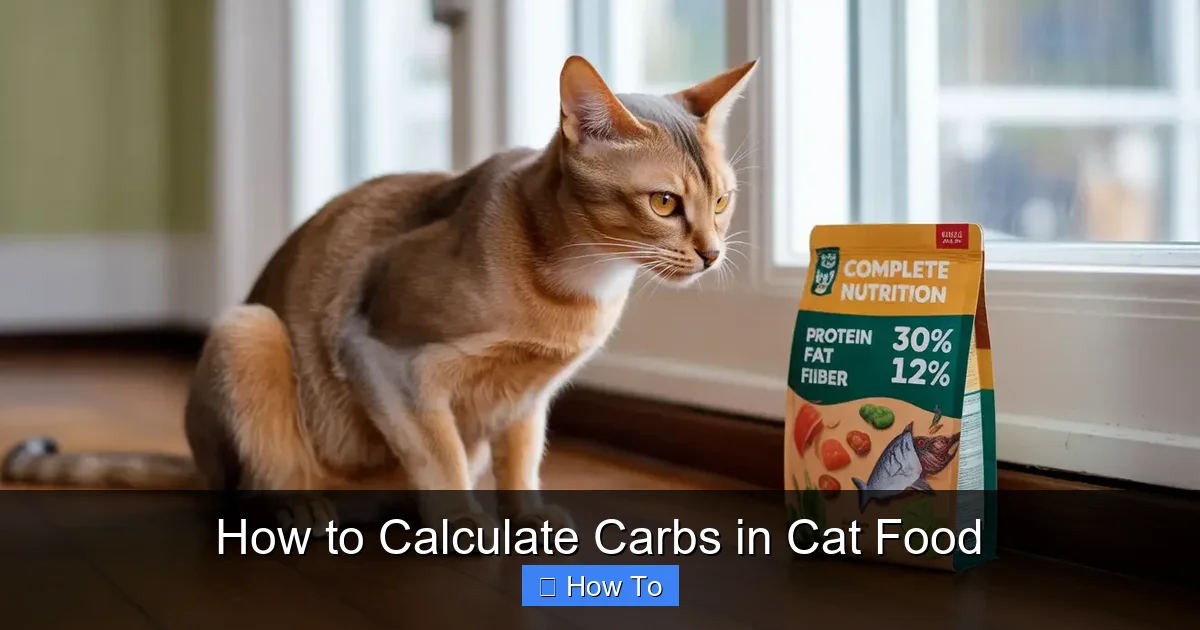
Understanding how to calculate carbs in cat food helps you make informed decisions about your cat’s diet. This guide walks you through simple steps to estimate carbohydrate content using guaranteed analysis and ingredient lists, so you can support your feline’s health with confidence.
Key Takeaways
- Carbohydrates aren’t listed directly on pet food labels: You’ll need to calculate them using the guaranteed analysis and ingredient information.
- Use the “calorie subtraction method” for accuracy: Subtract protein, fat, moisture, and ash from 100% to estimate carb content.
- Look for low-carb, high-protein ingredients: Meat, poultry, and fish should be at the top of the ingredient list.
- Ash content affects calculations: Assume 5–8% ash if not listed, as it’s often omitted from labels.
- Wet food typically has fewer carbs than dry food: Moisture dilutes carb concentration, making wet food a better option for carb-conscious diets.
- Consult your vet before making dietary changes: Especially if your cat has diabetes, obesity, or kidney issues.
- Third-party tools can help: Online carb calculators and apps simplify the process for busy pet parents.
How to Calculate Carbs in Cat Food: A Complete Guide
If you’re a cat parent who cares about your feline friend’s health, you’ve probably heard that cats are obligate carnivores. That means their bodies are built to thrive on a diet rich in animal protein and low in carbohydrates. Yet, many commercial cat foods—especially dry kibble—are loaded with fillers like corn, wheat, and potatoes, which spike the carb content.
So how do you know how many carbs your cat is actually eating? The answer isn’t as simple as reading a nutrition label. Unlike human food, pet food labels don’t list carbohydrate content directly. That’s why learning how to calculate carbs in cat food is such a valuable skill.
In this guide, we’ll walk you through everything you need to know—from understanding why carbs matter for cats, to step-by-step methods for calculating carb content using information on the packaging. By the end, you’ll be able to compare brands, choose healthier options, and feel confident that you’re feeding your cat a diet that supports their natural biology.
Let’s dive in.
Why Carbohydrate Content Matters for Cats
Visual guide about How to Calculate Carbs in Cat Food
Image source: thecatsite.com
Before we get into the math, it’s important to understand why this matters in the first place. Cats evolved as hunters, eating small prey like mice and birds—foods that are high in protein and fat, and very low in carbohydrates. Their digestive systems aren’t designed to process large amounts of carbs efficiently.
When cats eat too many carbohydrates, especially from plant-based sources, it can lead to:
– Weight gain and obesity
– Increased risk of diabetes
– Urinary tract issues
– Poor digestion and gas
– Reduced nutrient absorption
Even though some carbs aren’t harmful in small amounts, many commercial cat foods contain far more than a cat needs. Dry food, in particular, often relies on grains and starches to hold kibble together, which can push carb content to 30% or higher.
That’s why knowing how to calculate carbs in cat food helps you make smarter choices. It empowers you to avoid hidden fillers and choose foods that align with your cat’s natural dietary needs.
Understanding Pet Food Labels
To calculate carbs, you first need to understand what information is available on a cat food label. Most labels include two key sections: the ingredient list and the guaranteed analysis.
Ingredient List
The ingredient list shows everything that goes into the food, listed in order by weight. Ingredients are measured before cooking, so water-heavy items like meat appear first—even if they lose moisture during processing.
Look for:
– Named animal proteins (e.g., “chicken,” “salmon,” “turkey”) at the top
– Minimal grains, potatoes, or legumes
– No vague terms like “meat by-products” or “animal digest”
For example, a high-quality food might list:
1. Chicken
2. Chicken broth
3. Chicken liver
4. Peas
5. Sunflower oil
This suggests a protein-rich base with some plant content.
Guaranteed Analysis
The guaranteed analysis provides minimum or maximum percentages for key nutrients:
– Crude protein (minimum %)
– Crude fat (minimum %)
– Crude fiber (maximum %)
– Moisture (maximum %)
Some labels also include:
– Ash (maximum %)
– Taurine
– Omega fatty acids
Note: Carbohydrates are not listed here. That’s why we need to calculate them.
Step-by-Step: How to Calculate Carbs in Cat Food
Now for the main event: calculating carbohydrate content. We’ll use a method called the “calorie subtraction method,” which is widely accepted by veterinarians and pet nutritionists.
This method works by estimating the percentage of the food that isn’t protein, fat, moisture, or ash. What’s left is mostly carbohydrates—along with a small amount of fiber and other minor components.
Here’s how to do it:
Step 1: Gather the Guaranteed Analysis
Find the guaranteed analysis on the back or side of the cat food packaging. You’ll need these four values:
– Crude protein (%)
– Crude fat (%)
– Moisture (%)
– Ash (%)
If ash isn’t listed, don’t worry—we’ll cover that in a moment.
Example (from a dry cat food label):
– Crude protein: 32%
– Crude fat: 15%
– Moisture: 10%
– Ash: 7%
Step 2: Assume Ash if Not Listed
Ash represents the mineral content left after burning off organic matter. It’s not actually “ash” in the food, but a measure of inorganic residue.
Many labels omit ash, but it typically ranges from 5% to 8% in dry food and 1% to 2% in wet food.
If ash isn’t listed:
– Use 7% for dry food
– Use 1.5% for wet food
This is a safe estimate for calculation purposes.
Step 3: Add Up the Known Components
Add the percentages for protein, fat, moisture, and ash.
Using our example:
– Protein: 32%
– Fat: 15%
– Moisture: 10%
– Ash: 7%
Total = 32 + 15 + 10 + 7 = 64%
Step 4: Subtract from 100%
Now subtract the total from 100% to find the remaining portion.
100% – 64% = 36%
This 36% represents everything not accounted for—mainly carbohydrates, plus a small amount of fiber and other trace elements.
So, in this example, the estimated carbohydrate content is about 36%.
Step 5: Adjust for Fiber (Optional but Helpful)
Fiber is a type of carbohydrate, but it’s not digestible by cats. Some of the “carb” percentage includes fiber, which you might want to separate for a more accurate digestible carb count.
If the label lists crude fiber (e.g., 3%), you can subtract it:
36% total carbs – 3% fiber = 33% digestible carbs
This gives you a clearer picture of how many carbs your cat can actually use for energy.
Calculating Carbs in Wet Cat Food
Wet food has a much higher moisture content—usually 70% to 80%—which changes how we interpret the numbers.
Let’s use an example:
Wet food guaranteed analysis:
– Crude protein: 10%
– Crude fat: 5%
– Moisture: 78%
– Ash: 2% (assumed if not listed)
Step 1: Add known components
10% (protein) + 5% (fat) + 78% (moisture) + 2% (ash) = 95%
Step 2: Subtract from 100%
100% – 95% = 5%
So, this wet food has about 5% carbohydrates.
But wait—this seems low, right? That’s because the high moisture content dilutes the concentration. To compare wet and dry food fairly, we need to calculate carbs on a dry matter basis.
Converting to Dry Matter Basis
Dry matter basis (DMB) removes the water so you can compare foods regardless of moisture content.
Here’s how:
1. Subtract moisture % from 100% to get dry matter.
– 100% – 78% = 22% dry matter
2. Divide the carb percentage by the dry matter percentage.
– 5% carbs ÷ 22% dry matter = 0.227
3. Multiply by 100 to get a percentage.
– 0.227 × 100 = 22.7%
So, on a dry matter basis, this wet food has about 22.7% carbohydrates.
Now you can compare it to dry food more accurately.
Using Online Carb Calculators
If math isn’t your thing, don’t worry—there are tools to help.
Several websites and apps allow you to input the guaranteed analysis and automatically calculate carb content.
Popular options include:
– Pet Nutrition Alliance’s Carb Calculator
– Feline Nutrition Foundation’s Food Analyzer
– CatFoodDB.com (compares brands and estimates carbs)
These tools save time and reduce errors. Just make sure to double-check the values you enter.
Tips for Choosing Low-Carb Cat Food
Now that you know how to calculate carbs, here are some practical tips for picking the best food for your cat:
1. Prioritize Animal Protein
Look for named meats (chicken, turkey, salmon) as the first ingredient. Avoid foods where grains or potatoes come before meat.
2. Choose Wet Over Dry When Possible
Wet food naturally has fewer carbs due to high moisture. It also helps with hydration, which is great for kidney health.
3. Watch for Hidden Carb Sources
Ingredients like corn, wheat, rice, potatoes, peas, and lentils are all high in carbs. Even “healthy” grains can add up.
4. Aim for Less Than 10% Carbs on Dry Matter Basis
For most cats, a carb content under 10% DMB is ideal. Diabetic or overweight cats may benefit from even lower levels.
5. Read Labels Carefully
Don’t rely on marketing claims like “grain-free” or “natural.” These don’t guarantee low carbs. Always check the guaranteed analysis.
Troubleshooting Common Issues
Even with the best methods, you might run into challenges. Here’s how to handle them:
Problem: Ash Isn’t Listed
Solution: Use 7% for dry food, 1.5% for wet food. This is a standard estimate used by pet nutrition experts.
Problem: Fiber Isn’t Listed
Solution: Assume 2–4% for dry food, 0.5–1% for wet food. Adjust your final carb count accordingly.
Problem: Ingredients List Confusing Terms
Solution: Avoid foods with vague terms like “meat meal” or “animal by-products.” Stick to named sources.
Problem: Carb Content Seems Too High
Solution: Double-check your math. If it’s still high, consider switching to a different brand or formula.
When to Consult Your Veterinarian
While calculating carbs is helpful, it’s not a substitute for professional advice.
Talk to your vet if:
– Your cat is overweight or obese
– Your cat has been diagnosed with diabetes
– Your cat has kidney disease or urinary issues
– You’re considering a raw or homemade diet
Your vet can help you determine the ideal carb level for your cat’s specific needs and health status.
Conclusion
Learning how to calculate carbs in cat food gives you powerful insight into what your feline friend is really eating. While pet food labels don’t list carbohydrates directly, you can estimate them using the guaranteed analysis and a simple subtraction method.
By focusing on high-protein, low-carb ingredients and using tools like dry matter calculations, you can choose foods that support your cat’s natural biology and long-term health.
Remember, every cat is different. What works for one may not work for another. Use this guide as a starting point, stay curious, and always prioritize your cat’s well-being.
With a little knowledge and effort, you can make feeding time a healthier, happier experience for both of you.