
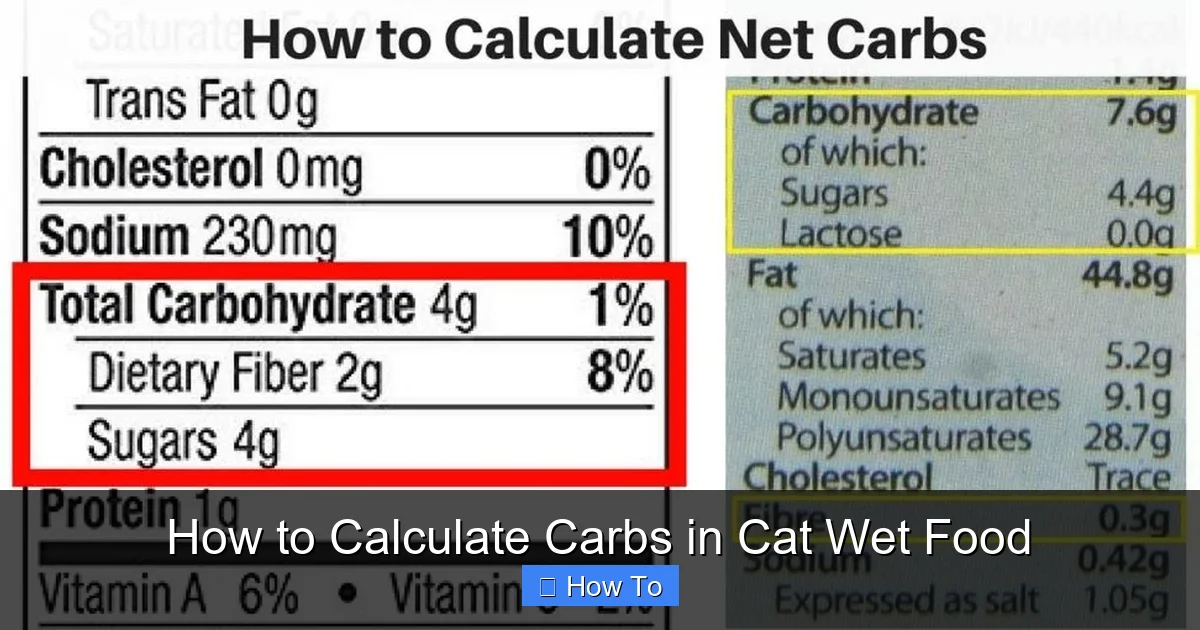
Understanding how to calculate carbs in cat wet food is essential for feeding your feline a diet that supports their natural carnivorous needs. This guide walks you through simple methods to estimate carbohydrate content using guaranteed analysis and ingredient lists, helping you make informed choices for your cat’s health.
Key Takeaways
- Carbohydrates aren’t listed directly on pet food labels: You’ll need to calculate them using the guaranteed analysis and ingredient information.
- Use the “100% minus” method: Subtract the percentages of moisture, protein, fat, and ash from 100% to estimate carbs.
- Look for high-moisture, low-ash foods: These typically have fewer hidden carbs and are better for cats.
- Ingredient order matters: Foods listing grains or starches early often contain more carbs.
- Not all carbs are bad: Some fiber is healthy, but cats need very low overall carb intake.
- Use online calculators as a backup: Tools like the Pet Nutrition Alliance’s calculator can help verify your math.
- Consult your vet: Always discuss dietary changes with a veterinarian, especially for cats with health conditions.
How to Calculate Carbs in Cat Wet Food
If you’re a cat parent who cares about your feline’s health, you’ve probably heard that cats are obligate carnivores. That means their bodies are built to thrive on a diet rich in animal protein and very low in carbohydrates. Unlike dogs or humans, cats don’t need carbs to survive—and too many can lead to obesity, diabetes, and digestive issues.
But here’s the catch: pet food labels don’t list carbohydrate content directly. So how do you know if your cat’s wet food is low in carbs? The answer lies in a little bit of math and smart label reading.
In this guide, you’ll learn exactly how to calculate carbs in cat wet food using simple, proven methods. We’ll walk you through reading labels, understanding guaranteed analysis, and using the “100% minus” formula. You’ll also get practical tips, real-life examples, and troubleshooting advice to make sure you’re feeding your cat the best possible diet.
By the end of this guide, you’ll be confident in choosing wet foods that support your cat’s natural biology—without the guesswork.
Why Carbohydrate Content Matters for Cats

Visual guide about How to Calculate Carbs in Cat Wet Food
Image source: ketovale.com
Before we dive into the calculations, let’s talk about why this matters. Cats evolved as hunters, eating small prey like mice and birds. Their meals were high in protein and fat, with almost no carbohydrates. Their bodies are designed to use protein for energy, not glucose from carbs.
When cats eat too many carbs, their bodies can’t process them efficiently. This can lead to:
- Weight gain and obesity
- Insulin resistance
- Type 2 diabetes
- Dental problems
- Digestive upset
Wet food is generally better than dry kibble because it’s higher in moisture and often lower in carbs. But not all wet foods are created equal. Some contain fillers like corn, wheat, rice, or potatoes—ingredients that spike carb content.
That’s why knowing how to calculate carbs in cat wet food is so important. It helps you avoid hidden carbs and choose foods that align with your cat’s natural dietary needs.
Understanding Pet Food Labels
Pet food labels can be confusing. They’re packed with terms like “guaranteed analysis,” “crude protein,” and “ash.” But don’t worry—we’ll break it down.
The two most important sections for calculating carbs are:
- Guaranteed Analysis: This shows the minimum or maximum percentages of key nutrients like protein, fat, fiber, and moisture.
- Ingredient List: Ingredients are listed by weight, so the first few items make up most of the food.
Let’s look at each in detail.
Reading the Guaranteed Analysis
The guaranteed analysis is usually found on the back or side of the can or pouch. It looks something like this:
- Crude Protein (min): 10.0%
- Crude Fat (min): 7.0%
- Crude Fiber (max): 1.5%
- Moisture (max): 78.0%
- Ash (max): 2.5%
Note: “Crude” just means it’s measured in a lab—it doesn’t mean the quality is low.
Here’s what each term means:
- Crude Protein: The total amount of protein, including both animal and plant sources.
- Crude Fat: The total fat content, essential for energy and skin health.
- Crude Fiber: Indigestible plant material. Some fiber is good, but too much can mean fillers.
- Moisture: The water content. Wet food is typically 70–85% moisture.
- Ash: The mineral content left after burning the food. It includes calcium, phosphorus, and other minerals.
Notice that carbohydrates aren’t listed. That’s why we need to calculate them.
Decoding the Ingredient List
The ingredient list tells you what’s actually in the food. Ingredients are listed in order by weight, so the first ingredient is the most abundant.
For low-carb diets, you want to see:
- Animal protein first (e.g., chicken, turkey, salmon)
- Minimal grains, starches, or fillers
- No corn, wheat, soy, rice, or potatoes near the top
For example, a good ingredient list might start with:
- Chicken, chicken broth, chicken liver
A higher-carb list might include:
- Chicken, rice, corn gluten meal, peas
Even if the food claims to be “grain-free,” it might still contain high-carb ingredients like potatoes or tapioca. That’s why reading the full list is crucial.
Step-by-Step: How to Calculate Carbs in Cat Wet Food
Now for the main event: the math. Don’t worry—it’s easier than it sounds.
We’ll use the “100% minus” method, which estimates carbs by subtracting all the known components from 100%.
Here’s the formula:
Carbohydrates (%) = 100% – (Moisture % + Protein % + Fat % + Ash % + Fiber %)
Let’s walk through it step by step.
Step 1: Gather the Guaranteed Analysis
Find the guaranteed analysis on the label. You’ll need the percentages for:
- Moisture
- Crude Protein
- Crude Fat
- Crude Fiber
- Ash
Let’s use a real example. Suppose you have a can of wet food with this analysis:
- Moisture: 78.0%
- Crude Protein: 10.0%
- Crude Fat: 7.0%
- Crude Fiber: 1.5%
- Ash: 2.5%
Step 2: Add Up the Known Percentages
Now, add all these numbers together:
78.0 (moisture) + 10.0 (protein) + 7.0 (fat) + 1.5 (fiber) + 2.5 (ash) = 99.0%
Step 3: Subtract from 100%
Now subtract that total from 100%:
100% – 99.0% = 1.0%
So, the estimated carbohydrate content is 1.0%.
That’s excellent! This food is very low in carbs—perfect for a cat.
Step 4: Interpret the Result
Here’s a general guideline for carb levels in cat food:
- 0–5%: Excellent—ideal for most cats
- 5–10%: Moderate—acceptable, but not ideal for diabetic or overweight cats
- 10%+: High—avoid if possible
In our example, 1.0% is well within the ideal range.
Practical Tips for Accurate Calculations
Now that you know the method, here are some tips to make sure your calculations are as accurate as possible.
Use As-Fed Basis, Not Dry Matter
Pet food labels show nutrients on an “as-fed” basis, meaning they include moisture. This is important because wet food has a lot of water, which dilutes the percentages.
Some people convert to “dry matter basis” to compare wet and dry foods, but for carb calculation, stick with as-fed. It’s simpler and more practical for everyday use.
Watch Out for Rounding Errors
This gives you a more accurate estimate.
Account for Fiber Separately
Fiber is a type of carbohydrate, but it’s not digestible. Some cat owners subtract fiber from the total carb count to get “net carbs,” similar to how humans do it.
To calculate net carbs:
Net Carbs = Total Carbs – Fiber
Using our earlier example:
Total Carbs = 1.0%
Fiber = 1.5%
Wait—that would give us a negative number! That’s because our total carb estimate was already very low. In this case, the fiber might be overestimated, or the food has very little digestible carbs.
In practice, if total carbs are low (under 5%), you don’t need to worry much about net carbs. But for higher-carb foods, subtracting fiber can give you a better idea of how many carbs your cat can actually absorb.
Double-Check with Online Tools
If you’re unsure about your math, use an online carb calculator. The Pet Nutrition Alliance offers a free tool that does the calculation for you—just input the guaranteed analysis.
These tools are great for verifying your results, especially when comparing multiple brands.
Real-Life Examples: Comparing Two Cat Foods
Let’s put this into practice with two real-world examples.
Example 1: Low-Carb Wet Food
Brand: Tiki Cat Grill
Flavor: Chicken in Broth
Guaranteed Analysis:
- Moisture: 78.0%
- Crude Protein: 12.0%
- Crude Fat: 3.0%
- Crude Fiber: 1.0%
- Ash: 2.0%
Calculation:
100 – (78 + 12 + 3 + 1 + 2) = 100 – 96 = 4.0% carbs
This is a great choice—high protein, low fat, and very low carbs.
Example 2: Higher-Carb Wet Food
Brand: Purina Fancy Feast
Flavor: Grilled Seafood
Guaranteed Analysis:
- Moisture: 78.0%
- Crude Protein: 9.0%
- Crude Fat: 3.0%
- Crude Fiber: 1.5%
- Ash: 2.5%
Calculation:
100 – (78 + 9 + 3 + 1.5 + 2.5) = 100 – 94 = 6.0% carbs
Still moderate, but higher than the first option. Also, check the ingredient list—this one contains wheat gluten and corn starch, which contribute to the carbs.
Troubleshooting Common Issues
Even with the right method, you might run into problems. Here’s how to handle them.
The Numbers Don’t Add Up to 100%
Sometimes, the percentages add up to more or less than 100%. This is normal due to rounding and lab variations.
If the total is over 100%, use the highest reasonable values. If it’s under, your carb estimate might be a bit high—but it’s still a good approximation.
Ash Isn’t Listed
Some labels don’t include ash. If that’s the case, assume 2–3% for wet food. Most wet foods have ash levels in this range.
For example, if ash isn’t listed, use 2.5% in your calculation.
Fiber Is Missing
If fiber isn’t listed, assume 1–2%. Most wet foods have low fiber, so 1.5% is a safe average.
The Food Claims to Be “Grain-Free” but Has High Carbs
Grain-free doesn’t mean carb-free. Ingredients like potatoes, peas, lentils, and tapioca are starchy and high in carbs.
Always check the ingredient list and do the math—don’t rely on marketing claims.
How to Choose the Best Low-Carb Wet Food
Now that you can calculate carbs, here’s how to pick the best food for your cat.
Look for High Animal Protein
The first ingredient should be a named animal protein (e.g., “chicken,” not “poultry by-product”).
Minimize Plant-Based Ingredients
Avoid foods with grains, starches, or legumes in the first five ingredients.
Choose High-Moisture Foods
Wet food should have at least 70% moisture. This supports kidney health and reduces the concentration of carbs.
Check the Carb Calculation
Aim for under 5% carbs. For diabetic or overweight cats, aim for under 3%.
Consider Your Cat’s Needs
Kittens, seniors, and cats with health conditions may have different dietary needs. Always consult your vet before making major changes.
Final Thoughts
Learning how to calculate carbs in cat wet food empowers you to make better choices for your feline friend. It’s not about eliminating all carbs—cats can tolerate small amounts—but about avoiding hidden fillers and supporting their natural carnivorous diet.
By using the “100% minus” method, reading labels carefully, and applying the tips in this guide, you can confidently select wet foods that promote health, energy, and longevity.
Remember, every cat is unique. What works for one may not work for another. When in doubt, talk to your veterinarian. They can help you tailor your cat’s diet to their specific needs.
With a little knowledge and a bit of math, you’re well on your way to feeding your cat the best possible food—naturally low in carbs and rich in the nutrients they truly need.