

Figuring out how much food to feed your cat doesn’t have to be confusing. This guide walks you through simple steps to calculate the right portion size based on your cat’s unique needs, helping them stay healthy and happy.
Key Takeaways
- Check the feeding guide on the food label: Most commercial cat foods include a recommended daily amount based on weight. Use this as a starting point, but adjust as needed.
- Consider your cat’s life stage: Kittens, adults, and senior cats have different calorie needs. Growing kittens need more food, while older cats may need less.
- Factor in activity level: Active cats burn more calories and may need larger portions, while indoor or sedentary cats require less to avoid weight gain.
- Monitor body condition, not just weight: Use the body condition score (BCS) to assess if your cat is underweight, ideal, or overweight. Adjust portions accordingly.
- Split meals into multiple feedings: Feeding 2–3 smaller meals per day supports digestion and mimics natural hunting behavior.
- Account for treats and wet vs. dry food: Treats should be no more than 10% of daily calories. Wet food is more filling and hydrating, which can affect portion sizes.
- Consult your vet for personalized advice: Health conditions like diabetes or kidney disease may require special diets and feeding plans.
How to Calculate How Much Food to Feed My Cat
Feeding your cat the right amount of food is one of the most important things you can do to keep them healthy, energetic, and at an ideal weight. But with so many types of food, varying activity levels, and different life stages, it’s easy to feel overwhelmed. How much is too much? How little is too little? The good news is that calculating how much food to feed your cat doesn’t have to be complicated.
In this guide, you’ll learn a clear, step-by-step method to determine the perfect portion size for your feline friend. We’ll cover everything from reading food labels and understanding calorie needs to adjusting for age, weight, and lifestyle. You’ll also get practical tips on monitoring your cat’s health and making changes when needed. By the end, you’ll feel confident in feeding your cat the right amount—every single day.
Step 1: Start with the Food Label
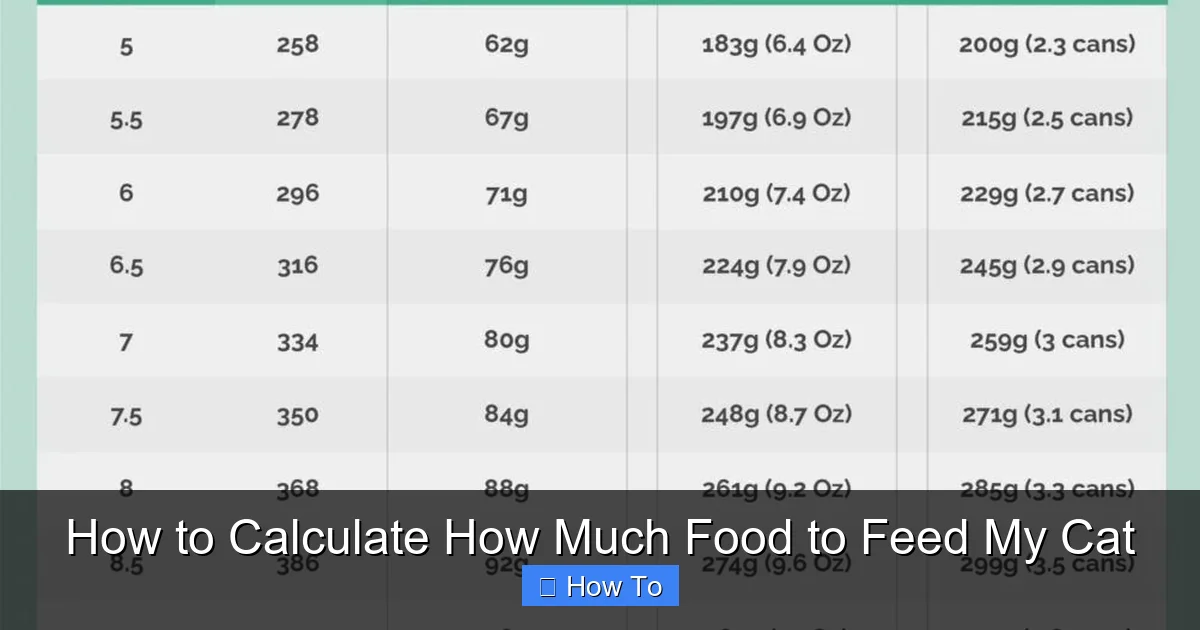
Visual guide about How to Calculate How Much Food to Feed My Cat
Image source: articles.hepper.com
The easiest place to begin is the feeding guide on your cat food packaging. Whether you’re using dry kibble or wet canned food, manufacturers provide recommended daily amounts based on your cat’s weight. These guidelines are a great starting point.
How to Read the Feeding Chart
Most labels include a chart that lists a range of weights (e.g., 5 lbs, 8 lbs, 10 lbs) and the corresponding amount of food in cups or grams. For example, a 10-pound adult cat might be advised to eat ½ to ¾ cup of dry food per day.
Keep in mind that these are general recommendations. They assume an average activity level and healthy weight. Your cat may need more or less depending on individual factors.
Check the Calorie Content
Look for the calorie information, usually listed as “kcal per cup” or “kcal per can.” This helps you understand how much energy your cat is getting. For instance, if a cup of dry food has 400 kcal and your cat needs 250 kcal per day, you’d feed about ⅝ cup.
Knowing the calorie count also helps when mixing wet and dry food or adding treats. You can balance the total daily intake more accurately.
Example: Using the Label
Let’s say you have an 8-pound adult cat. The label suggests ½ cup of dry food per day. But your cat is very active and loves to play. You might start with ½ cup and monitor their weight for two weeks. If they’re losing weight, increase slightly. If they’re gaining, reduce a little.
Step 2: Determine Your Cat’s Daily Calorie Needs
Every cat has a unique metabolic rate, but there are standard formulas to estimate their daily calorie requirements. This is especially helpful if your cat’s weight isn’t listed on the food label or if you’re making homemade meals.
Use the Resting Energy Requirement (RER) Formula
The RER is the number of calories your cat needs at complete rest. It’s calculated using this formula:
RER = 70 × (body weight in kg)^0.75
First, convert your cat’s weight from pounds to kilograms. Divide pounds by 2.2. For example, a 10-pound cat weighs about 4.5 kg.
Then plug it into the formula:
RER = 70 × (4.5)^0.75 ≈ 70 × 3.0 = 210 kcal/day
Adjust for Life Stage and Activity Level
Once you have the RER, multiply it by a factor based on your cat’s lifestyle:
- Neutered adult cat: RER × 1.2
- Intact adult cat: RER × 1.4
- Indoor, sedentary cat: RER × 1.0 to 1.2
- Active or outdoor cat: RER × 1.4 to 1.6
- Kitten (under 4 months): RER × 2.5 to 3.0
- Kitten (4–12 months): RER × 2.0
- Lactating queen: RER × 2.0 to 4.0 (depending on litter size)
- Senior cat (over 7 years): RER × 1.0 to 1.2 (may need fewer calories)
Example Calculation
Let’s say you have a 10-pound (4.5 kg) neutered indoor cat who plays occasionally but mostly naps.
RER = 210 kcal
Daily need = 210 × 1.2 = 252 kcal per day
Now, check your food’s calorie content. If the dry food has 400 kcal per cup, you’d feed about ⅝ cup (252 ÷ 400 = 0.63 cups).
Step 3: Consider Your Cat’s Life Stage
Cats have different nutritional needs at different stages of life. Feeding a kitten the same amount as an adult cat can lead to undernutrition or obesity.
Kittens (Under 1 Year)
Kittens grow rapidly and need more calories, protein, and fat. They should eat 2–3 times the amount of an adult cat per pound of body weight.
Feed kittens 3–4 small meals a day until they’re about 6 months old, then reduce to 2–3 meals. Use kitten-specific food, which is higher in calories and essential nutrients like DHA for brain development.
Adult Cats (1–7 Years)
Most adult cats need 20–30 calories per pound of body weight per day. A 10-pound cat typically needs 200–300 kcal daily.
Spayed or neutered cats often have slower metabolisms, so they may need 20–25% fewer calories than intact cats.
Senior Cats (7+ Years)
Older cats may become less active and lose muscle mass. They often need fewer calories but more high-quality protein to maintain muscle.
Some senior cats benefit from diets with added joint support, fiber, or lower phosphorus. Talk to your vet about age-appropriate food.
Pregnant or Nursing Cats
A pregnant or nursing queen needs significantly more food—up to twice her normal intake. Her calorie needs increase as kittens grow, peaking around week 6 of pregnancy and during lactation.
Feed her high-calorie, nutrient-dense food and allow free feeding (leaving food out all day) during nursing.
Step 4: Factor in Activity Level and Lifestyle
Just like people, cats have different energy levels. A playful indoor cat who chases toys all day will burn more calories than one who sleeps 18 hours.
Indoor vs. Outdoor Cats
Outdoor cats typically get more exercise and may need more food. However, they’re also at higher risk for injuries, parasites, and diseases, so monitor their weight closely.
Indoor cats are more prone to obesity. Limit portions and encourage play with interactive toys, puzzle feeders, or laser pointers.
Sedentary Cats
If your cat spends most of the day sleeping, reduce their food by 10–20% from the standard recommendation. Consider switching to a weight management formula, which is lower in calories but still nutritious.
Active or Working Cats
Farm cats, barn cats, or those who hunt may need extra food. Increase portions gradually and watch for weight loss.
Step 5: Monitor Body Condition, Not Just Weight
Weighing your cat is helpful, but it doesn’t tell the whole story. A cat can be overweight even if they’re within the “normal” weight range for their breed.
Use the Body Condition Score (BCS)
The BCS is a 5- or 9-point scale used by vets to assess body fat. Here’s a simple 5-point version:
- 1 (Emaciated): Ribs, spine, and bones are highly visible. No fat cover.
- 2 (Underweight): Ribs easily felt, minimal fat. Spine visible.
- 3 (Ideal): Ribs felt with slight fat cover. Waist visible from above, abdominal tuck from the side.
- 4 (Overweight): Ribs felt with difficulty. No waist, rounded abdomen.
- 5 (Obese): Ribs not felt. Large fat deposits, no waist, bulging belly.
Aim for a BCS of 3. If your cat is a 4 or 5, reduce food by 10–20% and increase activity. If they’re a 1 or 2, increase portions and consult your vet.
How to Check at Home
Run your hands gently over your cat’s ribs. You should be able to feel them without pressing hard. Look down from above—there should be a slight waist behind the ribs. From the side, the belly should tuck up.
Step 6: Decide Between Wet, Dry, or Mixed Feeding
The type of food you choose affects how much to feed.
Wet Food
Wet food is about 70–80% water, so it’s more filling and hydrating. It’s often lower in carbohydrates and higher in protein, which many cats prefer.
Because it’s less calorie-dense, you may need to feed more by volume. For example, a 5.5-oz can might have only 150–200 kcal.
Feeding wet food can help with hydration, especially for cats prone to urinary issues.
Dry Food
Dry kibble is convenient and can be left out for free feeding. It’s more calorie-dense, so smaller portions are needed.
However, some cats overeat when food is always available. Use a timed feeder or measure portions to prevent obesity.
Mixed Feeding
Many owners combine wet and dry food. For example, wet food in the morning and dry at night.
To calculate mixed feeding:
- Add up the total daily calorie need (e.g., 250 kcal).
- Decide how much will come from wet and how much from dry.
- Example: 150 kcal from wet food (one 5.5-oz can) + 100 kcal from dry food (¼ cup at 400 kcal/cup).
This approach offers variety and helps with hydration.
Step 7: Account for Treats and Supplements
Treats are fun, but they add calories. The general rule is that treats should make up no more than 10% of your cat’s daily caloric intake.
Calculate Treat Calories
If your cat needs 250 kcal per day, treats should be under 25 kcal.
Check treat packaging for calorie info. A single dental treat might be 10–15 kcal. A small piece of cooked chicken could be 20–30 kcal.
Healthy Treat Options
- Small pieces of cooked, unseasoned chicken or fish
- Commercial low-calorie treats
- Freeze-dried meat bites (portion-controlled)
- Interactive treat toys that dispense kibble
Avoid giving table scraps, especially fatty or spicy foods.
Supplements
Fish oil, probiotics, or joint supplements are usually low in calories but check labels. Some liquid supplements can add up.
Step 8: Establish a Feeding Schedule
When and how often you feed matters as much as how much.
How Many Meals Per Day?
Cats are natural grazers and prefer small, frequent meals. Aim for 2–3 meals daily.
Kittens need 3–4 meals. Senior cats may prefer smaller, more frequent feedings if they have digestive issues.
Free Feeding vs. Scheduled Feeding
Free feeding (leaving dry food out all day) is convenient but can lead to overeating. It’s best for cats who self-regulate well.
Scheduled feeding (measured meals at set times) helps control portions and monitor appetite. It’s ideal for overweight cats or multi-cat households.
Use Puzzle Feeders
Puzzle feeders slow down eating and stimulate mental activity. They’re great for indoor cats and can help prevent boredom-related overeating.
Step 9: Adjust Portions Over Time
Your cat’s needs change with age, health, and lifestyle. Regularly reassess their food intake.
Weigh Your Cat Monthly
Use a pet scale or weigh yourself holding your cat, then subtract your weight. Track changes over time.
A healthy weight gain or loss is about 1–2% per week. More than that may signal a problem.
Watch for Signs of Overfeeding
- Weight gain or difficulty feeling ribs
- Lethargy or reluctance to play
- Difficulty grooming (especially in long-haired cats)
- Vomiting or diarrhea (if eating too fast or too much)
Watch for Signs of Underfeeding
- Weight loss or visible ribs
- Increased appetite or begging
- Dull coat or low energy
- Weakness or behavioral changes
Make Gradual Changes
If you need to increase or decrease food, do it slowly—over 5–7 days. Sudden changes can upset your cat’s stomach.
Troubleshooting Common Feeding Problems
My Cat Is Always Hungry
This could mean they’re not getting enough calories, or they have a medical issue like hyperthyroidism or diabetes. Check their body condition and consult your vet.
My Cat Won’t Eat the Recommended Amount
Some cats are picky or have slower metabolisms. Try warming wet food slightly or offering a different flavor. Never force-feed.
My Cat Is Gaining Weight
Reduce portions by 10–15%, increase playtime, and switch to a weight-control formula. Avoid free feeding.
My Cat Is Losing Weight
Increase food gradually. Rule out dental pain, parasites, or illness with a vet visit.
Multiple Cats with Different Needs
Feed cats separately to ensure each gets the right amount. Use microchip-activated feeders or feed in different rooms.
When to Consult Your Veterinarian
While this guide helps you calculate how much food to feed your cat, your vet is the best resource for personalized advice.
Schedule a check-up if:
- Your cat’s weight changes rapidly
- They show signs of illness (vomiting, diarrhea, lethargy)
- They have a chronic condition like diabetes, kidney disease, or arthritis
- You’re unsure about portion sizes or food type
Your vet can recommend prescription diets, calculate precise calorie needs, and help manage weight safely.
Conclusion
Calculating how much food to feed your cat is a blend of science, observation, and love. Start with the food label, use the RER formula to estimate calorie needs, and adjust for age, activity, and body condition. Monitor your cat’s weight and energy levels, and don’t forget to account for treats and feeding style.
Remember, every cat is unique. What works for one may not work for another. Stay flexible, keep records, and consult your vet when in doubt.
By feeding your cat the right amount, you’re not just filling their bowl—you’re supporting their long-term health, happiness, and vitality. With a little attention and care, you’ll find the perfect balance that keeps your feline friend purring for years to come.