
Understanding how to calculate carbs in dry cat food helps you choose the best diet for your cat’s health. This guide walks you through a simple formula using guaranteed analysis and ingredient lists to estimate carbohydrate content accurately.
Key Takeaways
- Carbohydrates aren’t listed directly on pet food labels: You must calculate them using the guaranteed analysis and basic math.
- Use the 100% rule: Subtract protein, fat, moisture, ash, and fiber from 100% to estimate total carbs.
- Look for high moisture and low ash: These values affect carb accuracy—lower is usually better for carb estimation.
- Ingredient order matters: Foods listing grains or starches first tend to be higher in carbs.
- Not all carbs are bad: Some fiber supports digestion, but cats thrive on low-carb, high-protein diets.
- Compare foods on a dry matter basis: This removes moisture differences and gives a fair comparison.
- Use online calculators as a backup: They can help verify your math, but understanding the process is key.
How to Calculate Carbs in Dry Cat Food
If you’re a cat parent who cares about your furry friend’s health, you’ve probably heard that cats are obligate carnivores. That means their bodies are built to thrive on a diet rich in animal protein and low in carbohydrates. Yet, many commercial dry cat foods are packed with grains, potatoes, and other starchy ingredients—leading to hidden carbs that can contribute to obesity, diabetes, and digestive issues.
The problem? Carbohydrate content isn’t listed on pet food labels. Unlike human food, where you can easily find “Total Carbohydrates” on the nutrition facts panel, cat food labels only show protein, fat, moisture, ash, and fiber. So how do you figure out how many carbs your cat is actually eating?
The good news is that you can estimate the carbohydrate content using a simple formula. In this guide, we’ll walk you through how to calculate carbs in dry cat food step by step. You’ll learn what to look for on the label, how to do the math, and how to compare different brands like a pro. By the end, you’ll have the tools to make smarter, healthier choices for your cat—no veterinary degree required.
Why Carbohydrate Content Matters for Cats
Before we dive into the calculations, let’s talk about why this matters. Cats evolved as hunters, eating small prey like birds and mice. Their natural diet is high in protein, moderate in fat, and very low in carbohydrates—typically less than 10% on a dry matter basis.
Unlike dogs or humans, cats don’t need dietary carbohydrates. Their bodies aren’t efficient at processing large amounts of sugar or starch. In fact, high-carb diets have been linked to:
- Weight gain and obesity
- Type 2 diabetes
- Dental problems
- Inflammatory conditions
- Poor nutrient absorption
While some fiber (a type of carb) can support digestive health, most dry cat foods contain far more carbs than necessary. That’s why knowing how to calculate carbs in dry cat food is so important. It empowers you to choose foods that align with your cat’s natural dietary needs.
Understanding the Guaranteed Analysis
The first step in calculating carbs is understanding the guaranteed analysis on the back or side of the cat food bag. This section lists the minimum and maximum percentages of key nutrients. Here’s what you’ll typically see:
- Crude Protein (minimum %): The amount of protein in the food.
- Crude Fat (minimum %): The amount of fat.
- Crude Fiber (maximum %): The indigestible portion of plant material.
- Moisture (maximum %): The water content.
- Ash (maximum %): The mineral content left after burning the food.
Note: Ash isn’t a nutrient cats need to consume directly—it’s just a measure of inorganic minerals like calcium, phosphorus, and magnesium. But it’s part of the total composition, so we include it in our calculation.
Here’s an example from a popular dry cat food:
- Crude Protein: 32% (minimum)
- Crude Fat: 12% (minimum)
- Crude Fiber: 3% (maximum)
- Moisture: 10% (maximum)
- Ash: 8% (maximum)
These percentages are based on an “as-fed” basis, meaning they include the moisture in the food. But to get an accurate carb estimate, we need to work with dry matter values. We’ll cover that next.
Step 1: Convert to Dry Matter Basis
Dry matter basis (DMB) removes the moisture from the equation so you can compare foods fairly. Dry cat food typically has 6–10% moisture, while wet food can have 70–80%. Comparing them directly would be misleading.
To convert any nutrient to dry matter basis, use this formula:
Dry Matter % = (As-Fed % ÷ (100 – Moisture %)) × 100
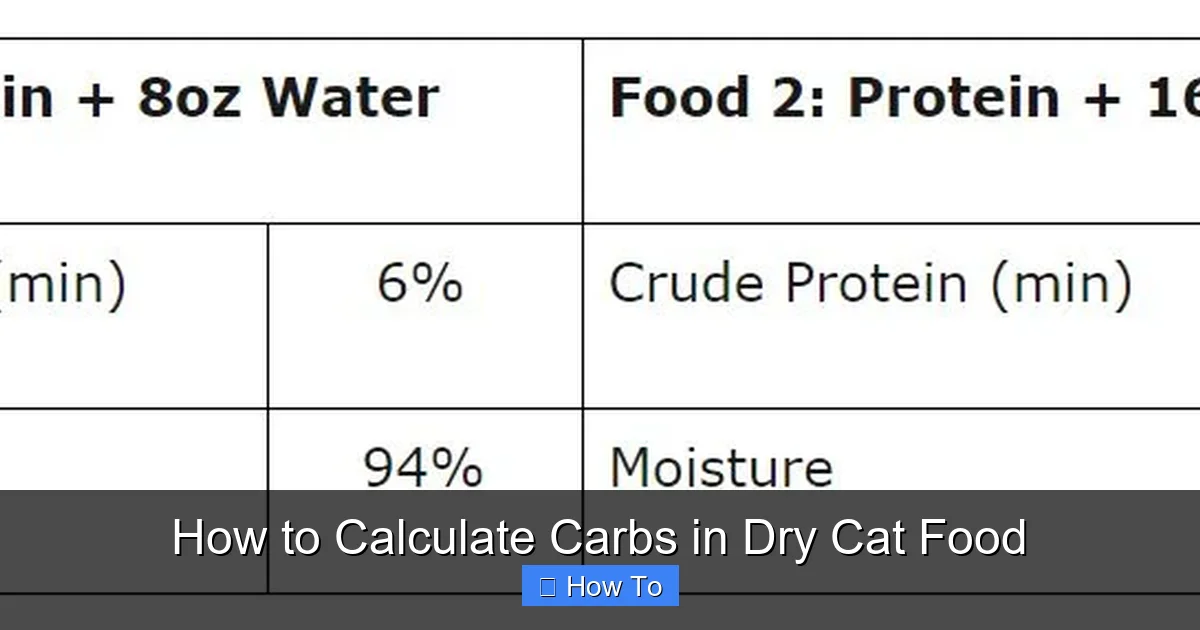
Visual guide about How to Calculate Carbs in Dry Cat Food
Image source: thecatsite.com
Let’s apply this to our example food with 10% moisture.
Calculate Dry Matter Protein
- As-fed protein: 32%
- Moisture: 10%
- Dry matter protein = (32 ÷ (100 – 10)) × 100 = (32 ÷ 90) × 100 ≈ 35.6%
So, the protein makes up about 35.6% of the dry matter.
Calculate Dry Matter Fat
- As-fed fat: 12%
- Dry matter fat = (12 ÷ 90) × 100 ≈ 13.3%
Calculate Dry Matter Fiber
- As-fed fiber: 3%
- Dry matter fiber = (3 ÷ 90) × 100 ≈ 3.3%
Calculate Dry Matter Ash
- As-fed ash: 8%
- Dry matter ash = (8 ÷ 90) × 100 ≈ 8.9%
Now we have all the major components on a dry matter basis. Next, we’ll use these to estimate carbohydrates.
Step 2: Use the 100% Rule to Estimate Carbs
Here’s the core principle: Everything in the food adds up to 100%. So if we subtract the known components (protein, fat, moisture, ash, and fiber), what’s left is mostly carbohydrates—plus a small amount of other stuff like vitamins and minerals, which we’ll ignore for simplicity.
The formula is:
Estimated Carbohydrates (%) = 100 – (Protein + Fat + Ash + Fiber)
We’re using dry matter values here, so let’s plug in the numbers from our example:
- Dry matter protein: 35.6%
- Dry matter fat: 13.3%
- Dry matter ash: 8.9%
- Dry matter fiber: 3.3%
Now calculate:
100 – (35.6 + 13.3 + 8.9 + 3.3) = 100 – 61.1 = 38.9%
So, this dry cat food contains approximately 38.9% carbohydrates on a dry matter basis.
That’s quite high for a cat’s diet. Ideally, you want to aim for under 10–15% carbs for most cats, especially if they’re overweight or diabetic.
Step 3: Double-Check with Ingredient Analysis
Math gives us an estimate, but the ingredient list can confirm whether the carb load makes sense. Ingredients are listed in order by weight, so the first few items make up the bulk of the food.
Let’s look at a sample ingredient list:
- Chicken
- Chicken Meal
- Brewer’s Rice
- Corn Gluten Meal
- Whole Grain Corn
- Poultry Fat
- Dried Beet Pulp
- Natural Flavor
- Fish Oil
- Potassium Chloride
Notice that after the first two animal-based ingredients, we see multiple plant-based items: brewer’s rice, corn gluten meal, whole grain corn, and beet pulp. These are all sources of carbohydrates.
Brewer’s rice and corn are starchy fillers. Beet pulp is a fiber source, but it still contributes to total carbs. The presence of these ingredients supports our calculation of nearly 39% carbs.
In contrast, a lower-carb food might list:
- Deboned Turkey
- Turkey Meal
- Chicken Meal
- Peas
- Tapioca
- Chicken Fat
- Flaxseed
- Natural Flavor
Here, animal proteins dominate the top of the list. Peas and tapioca are used in smaller amounts as binders or fiber sources. This food would likely have a much lower carb content—possibly under 20%.
Step 4: Compare Different Brands
Now that you know how to calculate carbs, let’s compare two popular dry cat foods.
Brand A: High-Carb Food
- Protein: 30% (as-fed)
- Fat: 12%
- Fiber: 4%
- Moisture: 10%
- Ash: 8%
Convert to dry matter:
- Protein: (30 ÷ 90) × 100 = 33.3%
- Fat: (12 ÷ 90) × 100 = 13.3%
- Fiber: (4 ÷ 90) × 100 = 4.4%
- Ash: (8 ÷ 90) × 100 = 8.9%
Carbs = 100 – (33.3 + 13.3 + 4.4 + 8.9) = 100 – 59.9 = 40.1%
Brand B: Lower-Carb Food
- Protein: 40%
- Fat: 18%
- Fiber: 3%
- Moisture: 10%
- Ash: 6%
Dry matter conversion:
- Protein: (40 ÷ 90) × 100 = 44.4%
- Fat: (18 ÷ 90) × 100 = 20%
- Fiber: (3 ÷ 90) × 100 = 3.3%
- Ash: (6 ÷ 90) × 100 = 6.7%
Carbs = 100 – (44.4 + 20 + 3.3 + 6.7) = 100 – 74.4 = 25.6%
Even though both foods have similar moisture and fiber, Brand B has significantly fewer carbs due to higher protein and fat and lower ash. This makes it a better choice for carb-conscious cat owners.
Practical Tips for Accurate Calculations
Now that you know the process, here are some tips to make your calculations more accurate and useful.
Use Maximum and Minimum Values Wisely
The guaranteed analysis shows ranges (e.g., “Crude Protein (min)”). For protein and fat, use the minimum value—it’s the lowest guaranteed amount. For fiber, moisture, and ash, use the maximum—it’s the highest allowed. This gives you a realistic estimate.
Watch Out for High Ash
Ash can vary widely between brands. Some foods have 10% or more ash, which can skew your carb calculation. Lower ash (under 8%) is generally better and leads to more accurate estimates.
Don’t Forget About Fiber
Fiber is a type of carbohydrate, but it’s not digestible. However, it still counts in the total carb calculation. Don’t subtract it—include it as part of the carb total.
Use Online Tools as a Backup
If math isn’t your thing, use free online carb calculators for pet food. Sites like PetFoodCalculator.com or Feline Nutrition Foundation’s tools can do the math for you. Just double-check their inputs and make sure they’re using dry matter values.
Track Over Time
Keep a spreadsheet of the foods you’re considering. Note the brand, protein, fat, fiber, moisture, ash, and calculated carbs. This makes it easy to compare and find the best options.
Troubleshooting Common Issues
Even with the right formula, you might run into some challenges. Here’s how to handle them.
The Label Doesn’t List Ash
Some pet food labels omit ash. If that’s the case, assume an average value of 6–8%. Use 7% as a default unless you have reason to believe it’s higher (e.g., the food contains bone meal or mineral supplements).
Moisture Is Missing
Moisture is usually listed, but if it’s not, assume 10% for dry food. Most kibble falls in the 6–12% range.
Results Seem Too High or Too Low
If your carb estimate is over 50% or under 5%, double-check your math. Also, review the ingredient list. If the food is loaded with grains but your calculation shows low carbs, you might have used the wrong moisture value or missed a component.
Wet Food vs. Dry Food
This guide focuses on dry food, but you can use the same method for wet food. Just remember that wet food has much higher moisture (70–80%), so the dry matter conversion is more dramatic. For example, a wet food with 10% protein and 78% moisture has a dry matter protein of (10 ÷ 22) × 100 ≈ 45.5%.
How to Choose a Low-Carb Dry Cat Food
Now that you can calculate carbs, here’s how to pick a better food for your cat.
Look for High Animal Protein
The first ingredient should be a named meat (e.g., “chicken,” “turkey,” “salmon”), not a by-product or grain. Aim for at least 35–40% protein on a dry matter basis.
Minimize Plant-Based Ingredients
Avoid foods that list corn, wheat, rice, potatoes, or peas near the top. These are carb-heavy fillers.
Check the Carb Estimate
Use the formula to calculate carbs. Aim for under 15% for most cats. Diabetic or overweight cats may benefit from under 10%.
Consider a Wet Food Alternative
If your cat will eat it, wet food is naturally lower in carbs because it contains more water and less starch. Many wet foods have under 5% carbs.
Transition Gradually
If switching foods, do it over 7–10 days. Mix increasing amounts of the new food with the old to avoid digestive upset.
Final Thoughts
Learning how to calculate carbs in dry cat food puts you in control of your cat’s nutrition. It’s a simple process once you understand the guaranteed analysis and the 100% rule. By converting to dry matter basis and subtracting protein, fat, ash, and fiber, you get a reliable estimate of carbohydrate content.
Remember, cats don’t need carbs—they need protein. High-carb diets can lead to health problems, so choosing a low-carb, high-protein food is one of the best things you can do for your cat’s long-term well-being.
Use this guide as a tool. Keep it handy when shopping, and don’t be afraid to do the math. Your cat will thank you with a healthier weight, better energy, and fewer vet visits.